Types of SaaS software: Categories, examples & use cases


The most common SaaS categories include CRM, ERP, accounting, project management, communication, HR, marketing, customer support, analytics, design, e-commerce, security, AI, and industry tools. Some of the most popular SaaS products are Zoom, Slack, Shopify, Figma, and Salesforce.
Why do the types of SaaS matter?
Imagine you are a founder of any SaaS product. You have a strong product idea, a small team, and a long list of tools to pick from. CRM or ERP? Slack or Teams? And should your own product be B2B or B2C, horizontal or vertical? Every choice feels big, because it is.
We've sat across from that founder many times. Since 2019, we have designed and built SaaS products for startups backed by YC, a16z, and Sequoia, and for AI companies such as HeyGen and Kodezi. And the same question keeps coming up: "Where does our product fit?"
That question matters more than it seems. When you know your SaaS product type, you know who your users are, what they are looking for, and what they will compare you to.
The market is huge and still growing. According to Gartner's July 2026 IT spending forecast, worldwide software spending will reach about $1.47 trillion in 2026, up 15.5% from 2025. But more money also means more noise.
In this guide, we explain the types of SaaS in simple terms. You will find actual SaaS examples, use cases, and how they work. We'll also discuss what we've learned about why some SaaS products succeed and others fail.
What is SaaS and how does it work?
SaaS (software as a service) is cloud-based software. You open it in a web browser or app, log in, and pay a monthly or yearly fee. The provider handles the servers, security, and updates.
According to the U.S. National Institute of Standards and Technology (NIST), SaaS means using a provider's apps that run on cloud systems, where the user doesn't manage the servers, storage, or operating system. In simple terms: you use it, they run it.
How does SaaS work?
Most SaaS products follow the same simple pattern:
- The provider hosts the software on its own cloud servers.
- Sign up and access via browser or app.
- Subscription, typically per user or per month.
- Updates are made in the background, so you're always up to date.
Many SaaS tools are multi-tenant. That means lots of customers share the same system, but each one only sees its own data.
What are the main advantages of SaaS?
- Lower upfront cost: no big license fee or hardware to buy.
- Fast setup: most teams get started in minutes, not months.
- Easy to scale: add or remove users as you grow.
- Work from anywhere: all you need is an internet connection.
- Automatic updates: new features show up without extra work.
But SaaS has trade-offs too. You have to rely on the provider, and costs can quickly add up.
According to Zylo's 2026 SaaS Management Index, about 36% of SaaS licenses go unused. That's money spent on tools nobody opens.
What is the difference between SaaS, PaaS, and IaaS?
SaaS is a cloud model and one of the three primary types of cloud models. The simplest way to ask them is: How much do you manage yourself?
Think of it like dinner. IaaS is a rented kitchen. PaaS is a meal kit. SaaS is a hot meal delivered to your door.
What are the main types of SaaS software?
The main types of SaaS software are sorted by the job they do. Most businesses employ multiple of them. In fact, the average company now has 305 SaaS applications to manage, according to Zylo's 2026 SaaS Management Index.
In this article, you will learn about 14 SaaS categories every product team and founder should know, with actual SaaS use cases and examples.
The majority of these are horizontal SaaS, meaning that any industry can utilize them. The final row is vertical SaaS, which is designed for one industry. We'll explain that difference below.
What are real SaaS examples in each category?
A table gives you the big picture. But each category has its own users, habits, and design needs. Here's a closer look at every one.
CRM SaaS Examples
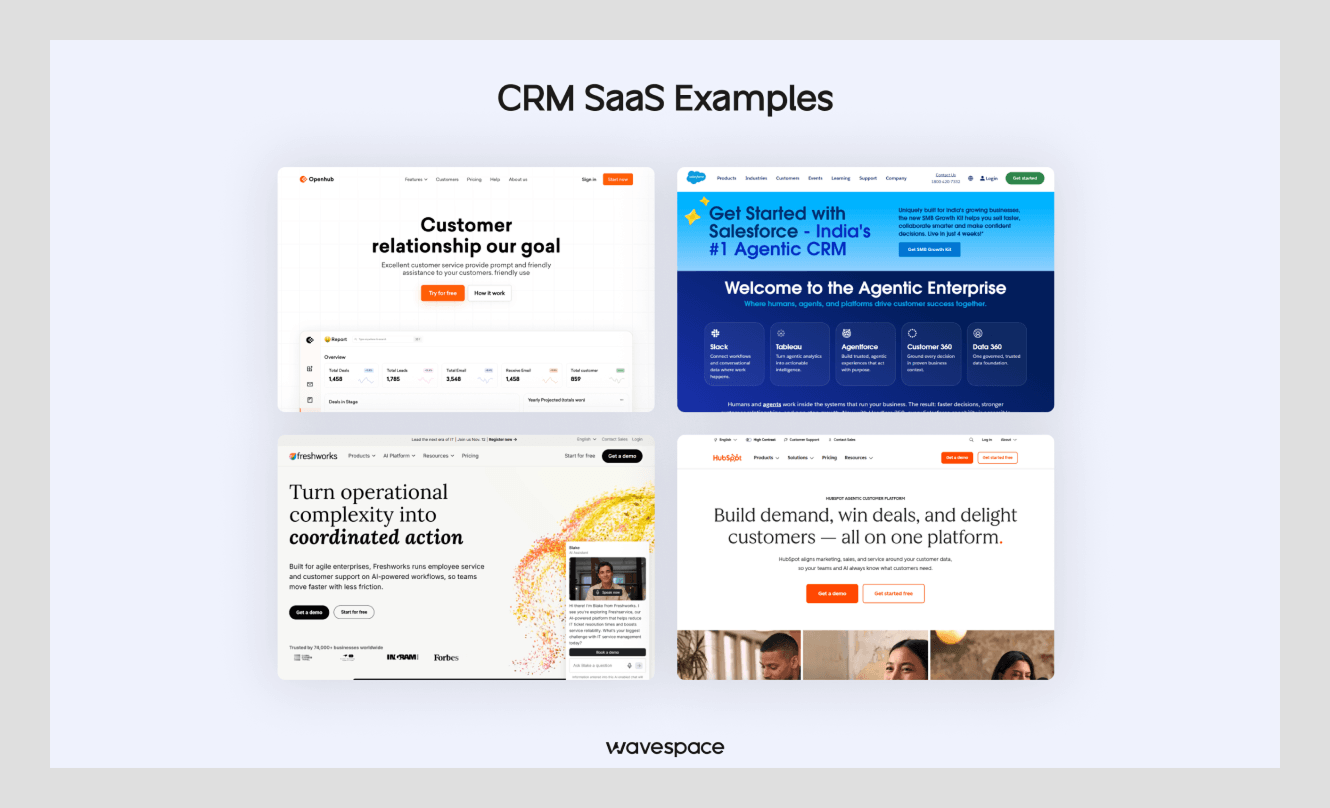
A Customer Relationship Management (CRM) system stores all leads, deals, and customer conversations in one place. The big names are Salesforce, HubSpot, Openhub, and Freshworks. Sales teams use them to track deals and know who to call next. A messy screen costs real money because it's a CRM that holds your entire sales history. If a rep doesn't like the interface, they won't log calls, and the data becomes stale.
ERP SaaS Examples
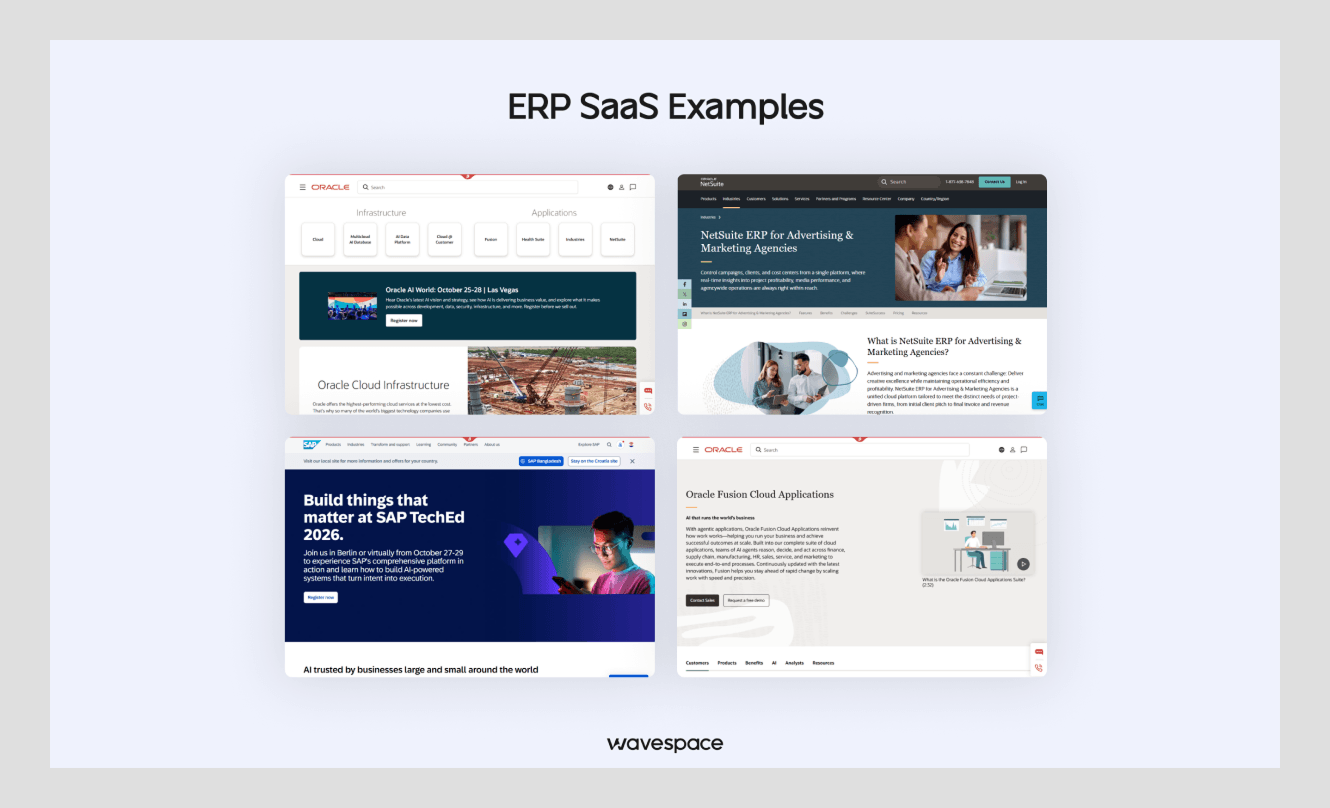
Enterprise resource planning (ERP) software connects finance, inventory, supply chain, and orders. Oracle NetSuite, SAP S/4HANA Cloud, and Oracle Fusion Cloud ERP lead this space. Mid-size and large companies use cloud ERP to see the whole business on one screen. ERP affects every department, making it the most challenging SaaS to implement successfully.
Accounting and Finance SaaS Examples
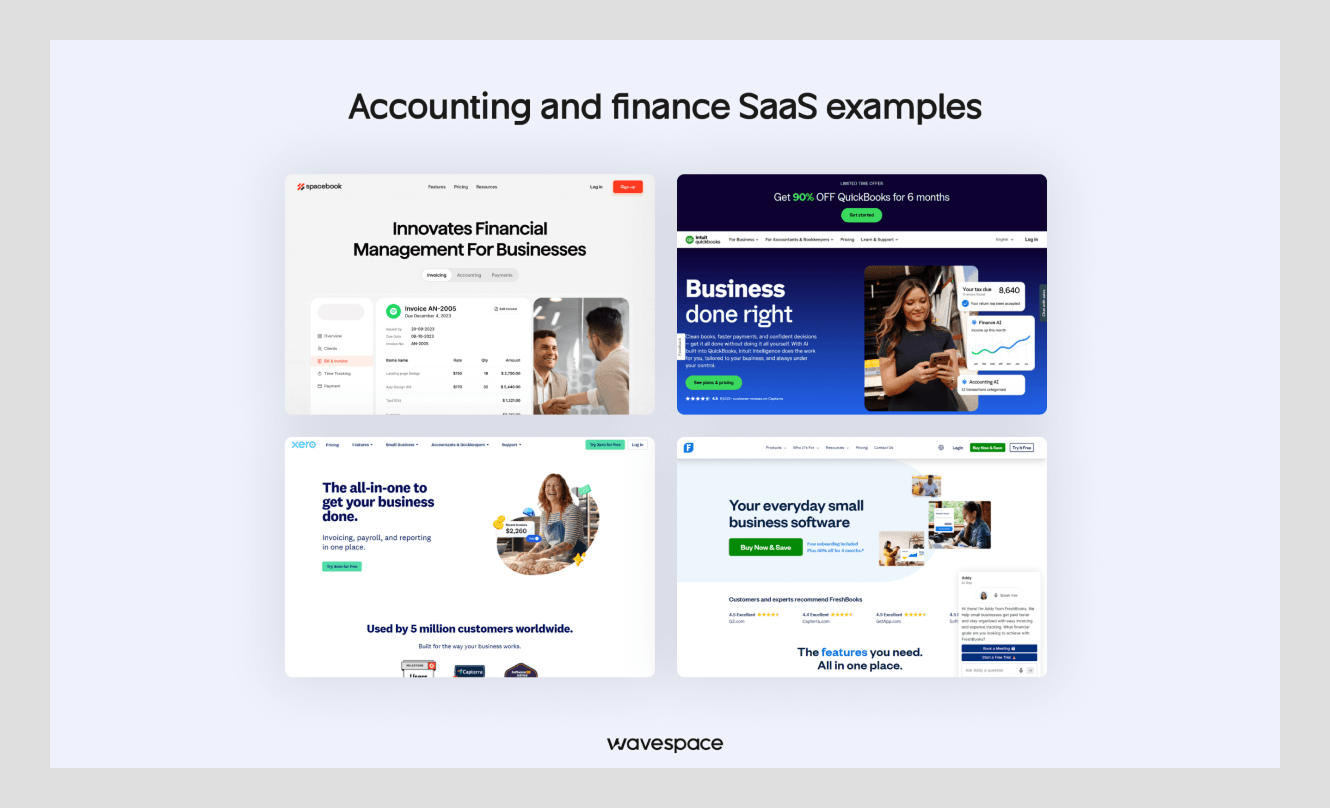
Spacebook, QuickBooks Online, Xero, and FreshBooks handle invoices, bookkeeping, expenses, and taxes. Small businesses love them because they replace piles of spreadsheets. Finance SaaS also links to bank accounts, so numbers update on their own. The right tools make difficult money jobs appear easy, and trust is established rapidly.
Project Management SaaS Examples
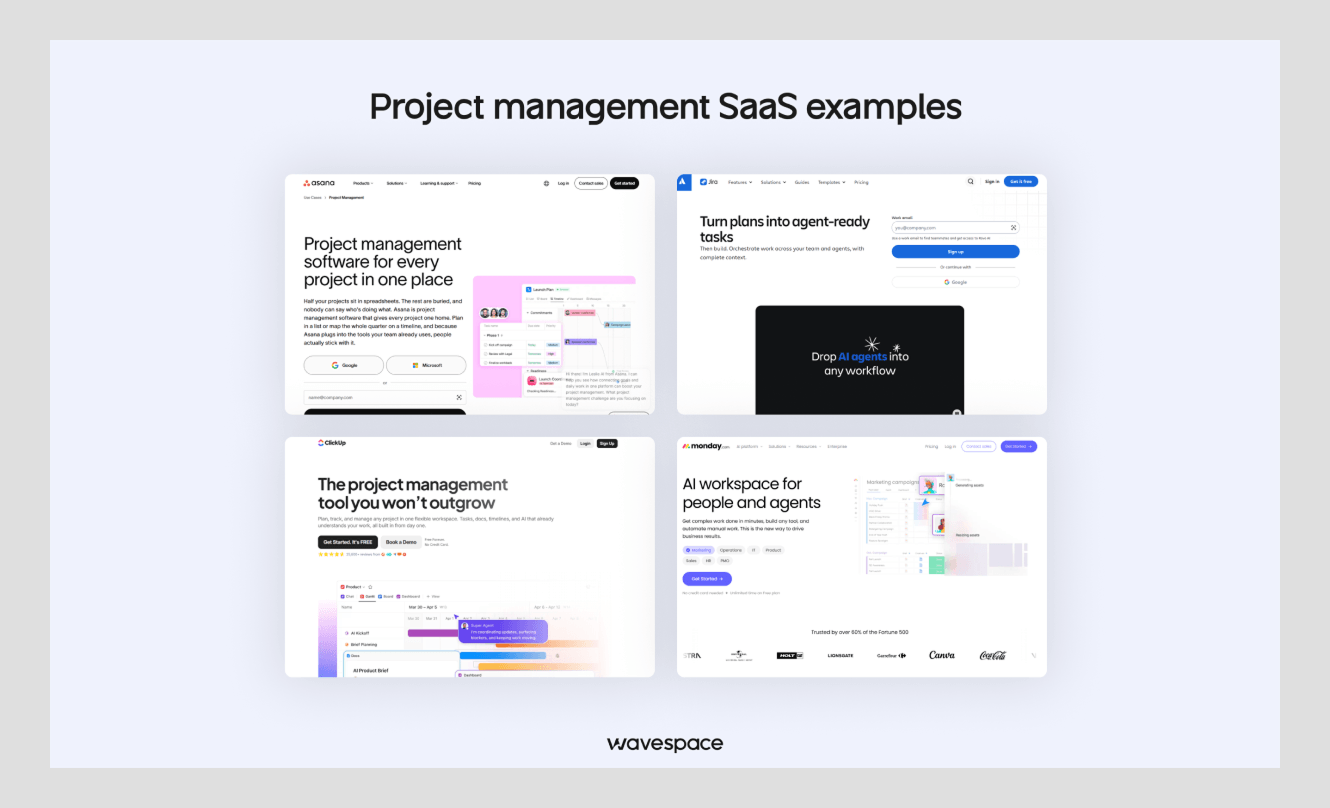
Teams plan, assign, and get work done with Asana, Jira, ClickUp, and Monday.com. Product teams often run sprints in Jira. Asana or Monday.com are the favorites for marketing and ops teams for their clear boards and timelines. The winner is usually the tool the whole team opens every day, not the one with the longest feature list.
Communication and Collaboration SaaS Examples
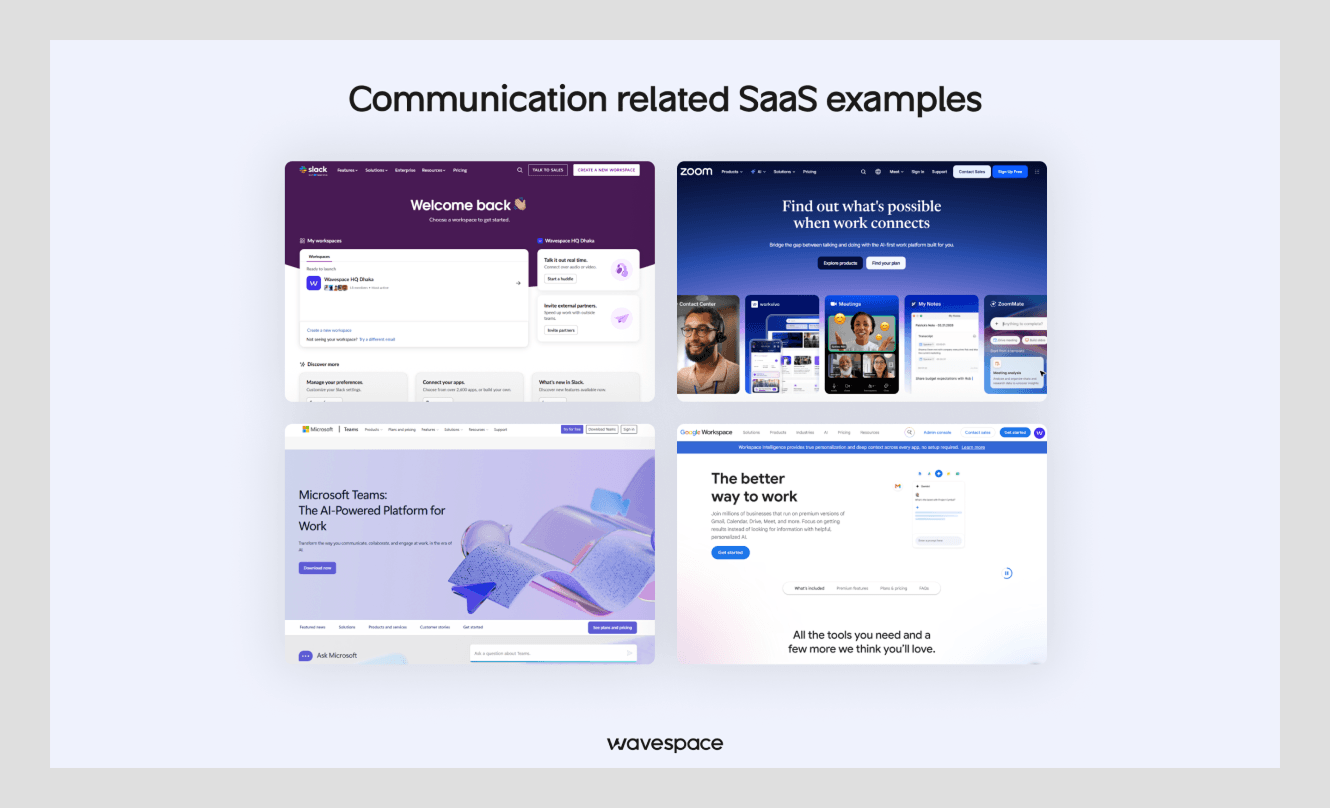
Remote and hybrid teams stay connected with Slack, Zoom, Microsoft Teams, and Google Workspace. They include chat, video calls, email, and shared docs. These tools became daily habits for millions of workers. But more tools also mean more switching between tabs. So, the best collaboration SaaS integrates seamlessly with the apps your team already uses.
HR SaaS Examples
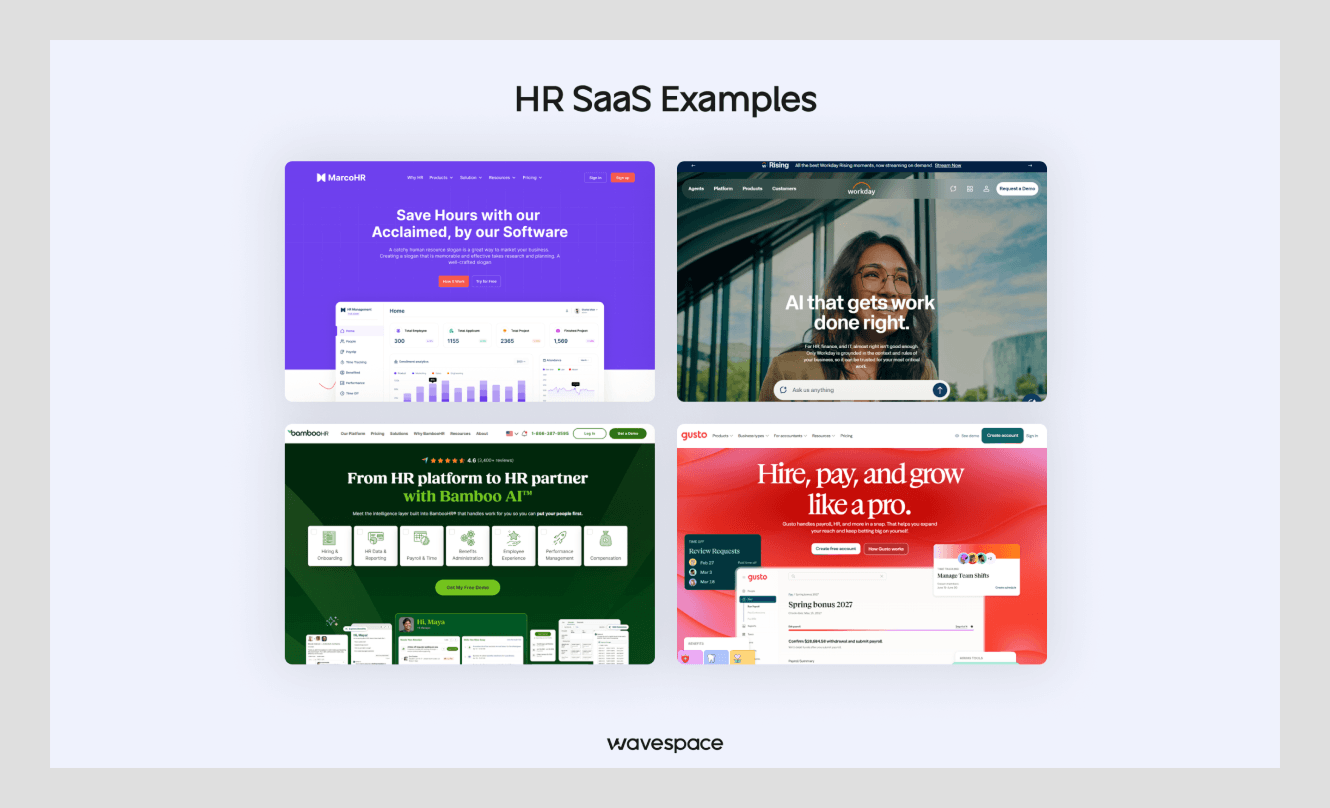
Workday, MarcoHR, BambooHR, Gusto, and Lattice handle everything from hiring to onboarding, payroll to benefits and reviews. HR SaaS eliminates hours of paperwork per month. It's also easy enough for someone logging in just twice a year, since every employee touches it.
Marketing Automation SaaS Examples
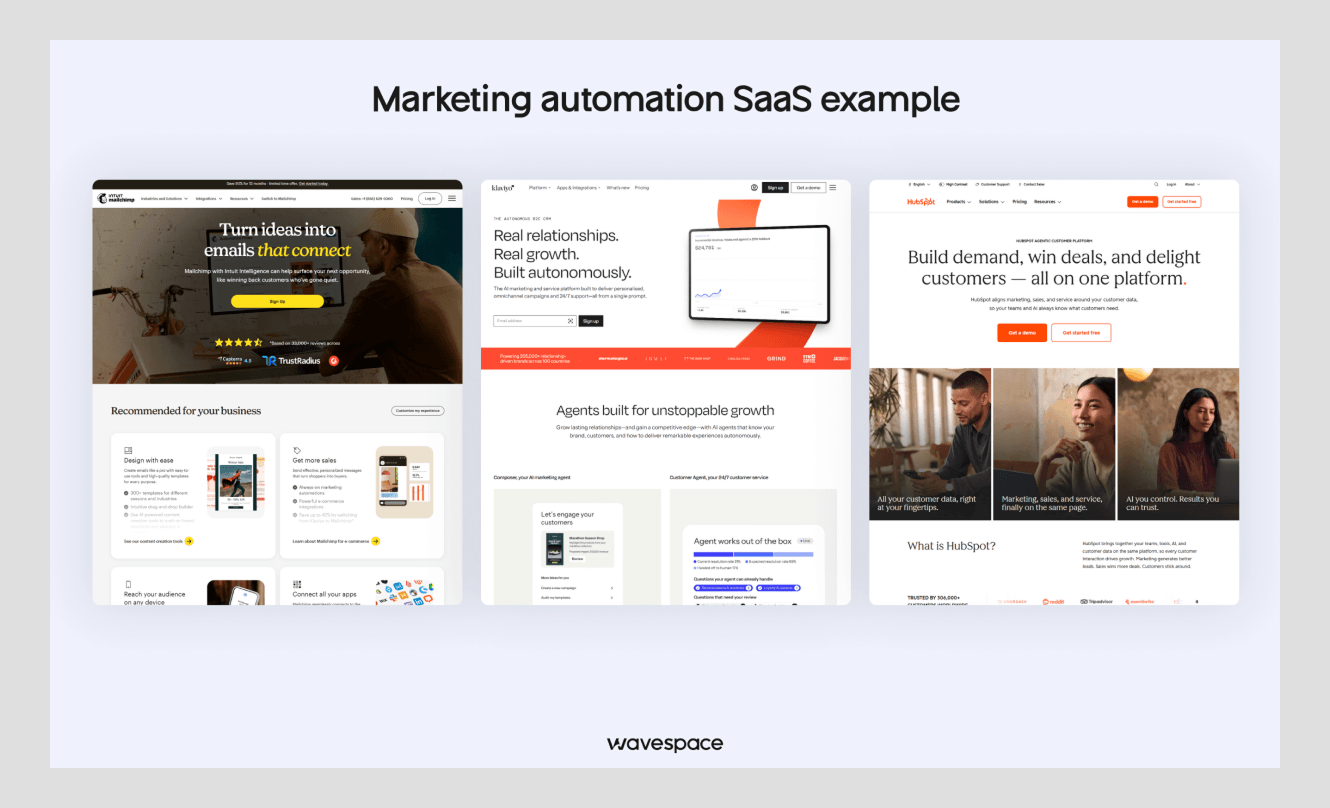
Sendwave, Mailchimp, Klaviyo, and HubSpot Marketing Hub send emails, manage campaigns, and score leads. Klaviyo is a popular choice for online stores. Mailchimp is a popular platform for many small businesses. Marketing SaaS can help a small team function as a large one, as it takes care of repetitive tasks in the background.
Customer Support SaaS Examples
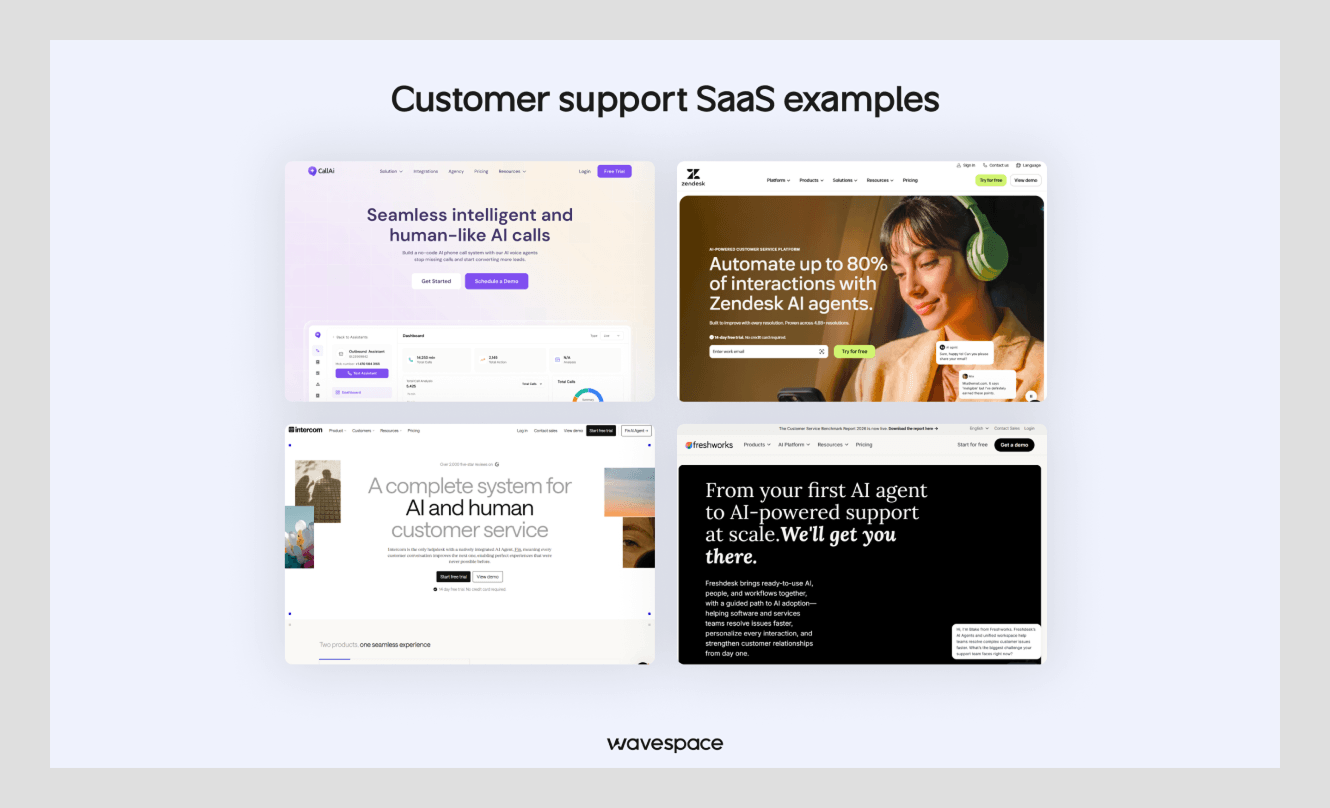
Call AI, Zendesk, Intercom, and Freshdesk run help desks, live chat, and self-service help centers. They are used by support teams to respond to tickets more quickly and monitor all customer issues. Many now include AI chatbots to deal with basic queries initially. Happy customers keep paying, and good support SaaS keeps them happy.
Analytics and BI SaaS Examples
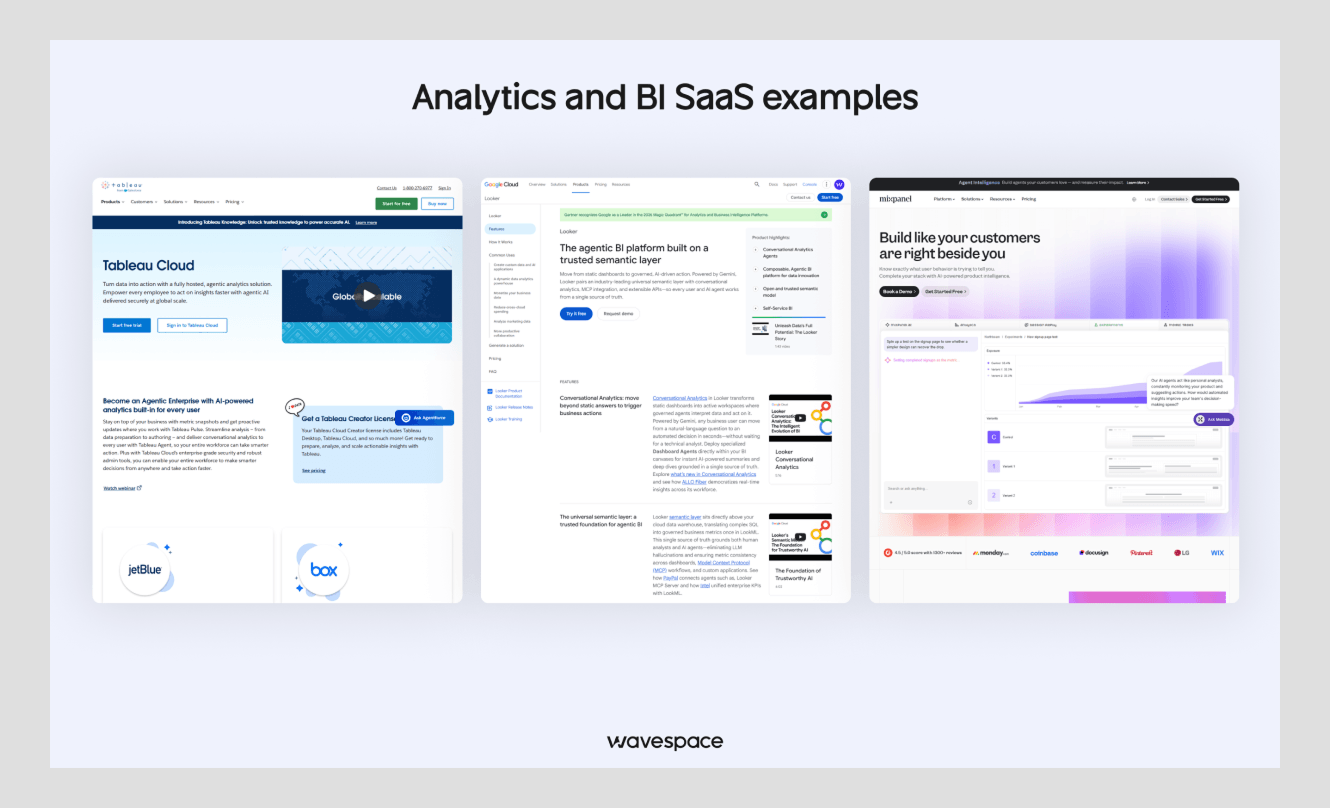
Tableau Cloud, Looker, and Mixpanel turn raw data into charts and dashboards. Leaders use business intelligence (BI) tools to spot trends. Product teams use Mixpanel to see where users drop off. As designers, we lean on product analytics all the time, because the data shows exactly where a user flow breaks.
Design and Content Creation SaaS Examples
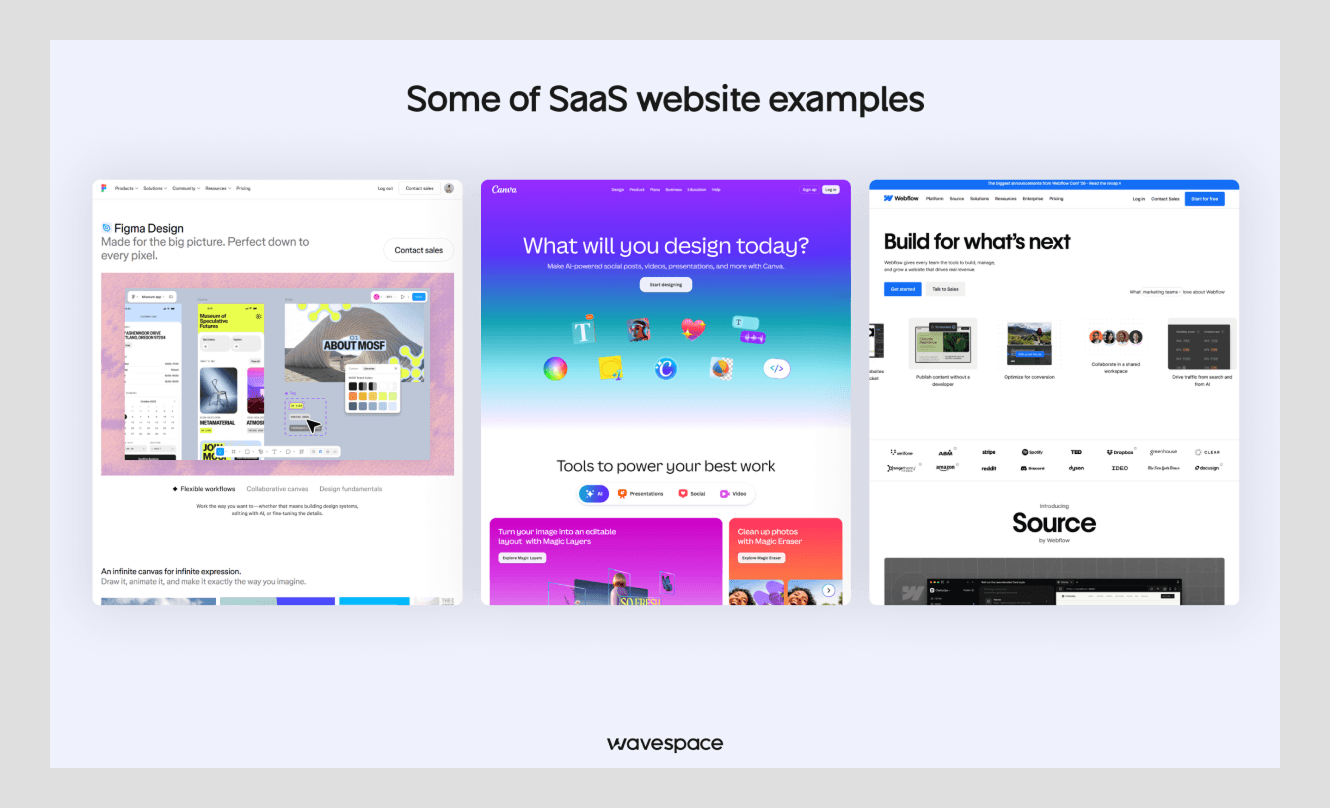
Figma, Canva, and Webflow allow teams to create, prototype, and publish directly in the browser. We use Figma for our UI design daily and, as a Webflow Certified Partner, we also create live websites on Webflow. Canva is easy to use for non-designers to create simple graphics. Together, these tools prove that creative work can live fully in the cloud.
Ecommerce SaaS Examples
Shopify and BigCommerce are used to drive online stores, checkouts, and point-of-sale systems. You don't need to write any code to start a store. These platforms handle payments, hosting, and security, so owners can focus on selling. But store design still matters a lot, because a confusing checkout loses sales.
Cybersecurity SaaS Examples
Okta, CrowdStrike Falcon, and 1Password protect logins, devices, and passwords. Okta handles single sign-on, so workers use one login for many apps. As companies add more SaaS tools, security SaaS becomes more important, not less. Every new app is one more door to lock.
AI SaaS Examples
Brainwind, ChatGPT, Jasper, and HeyGen show how fast AI SaaS is growing. These tools write text, create videos, and automate tasks. We've worked with HeyGen, so we've seen up close how much design matters for AI products. When the technology is complex, the interface has to feel simple, or users give up.
Vertical (Industry-Specific) SaaS Examples
Some SaaS is built for one industry only. Veeva serves life sciences, Toast serves restaurants, and Canvas LMS serves schools and colleges. You'll also find SaaS examples in healthcare, education, and finance that handle rules and workflows unique to those fields. Vertical SaaS wins by knowing its users deeply.
What are the types of SaaS by business model?
1. By target audience
B2B SaaS (Business-to-Business): Software designed for the use of organizations in managing operations, workflows, and teams (e.g., Salesforce, HubSpot, Slack).
B2C SaaS (Business-to-Consumer): Software intended for personal, non-business use for productivity, entertainment, or lifestyle (e.g., Netflix, Spotify).
2. By market scope
Horizontal SaaS: These are general-purpose applications that are used by companies in any industry or sector, like CRM or project management systems.
Vertical SaaS: Specialized software built for the unique workflow requirements of a single industry (e.g., dental clinic management systems or logistics fleet managers).
3. By company size & scale
Enterprise SaaS: Software that is designed to handle the needs of large organizations with complex multi-user hierarchies and stringent security requirements (such as Microsoft 365, NetSuite).
SMB SaaS: SMBs use it to manage routine tasks such as invoicing or scheduling with low-cost, affordable tools.
Micro-SaaS: Lean, hyper-focused software solving a single problem for a niche audience, often run by a solo founder or small team.
4. By delivery & technical model
API-First SaaS: Back-end infrastructure designed so other software applications can easily connect and automate workflows.
White-Label SaaS: One company creates mainly the core software. Then another company does the branding and marketing.
Open-Source / Open-Core SaaS: Software that has open-source code, and revenue is generated through managed cloud hosting or premium enterprise features.
Categories describe the function of a SaaS product. Business models explain who they are for and what they do to earn money. When founders ask us where their product fits, these four lenses help the most.
What is the difference between horizontal and vertical SaaS?
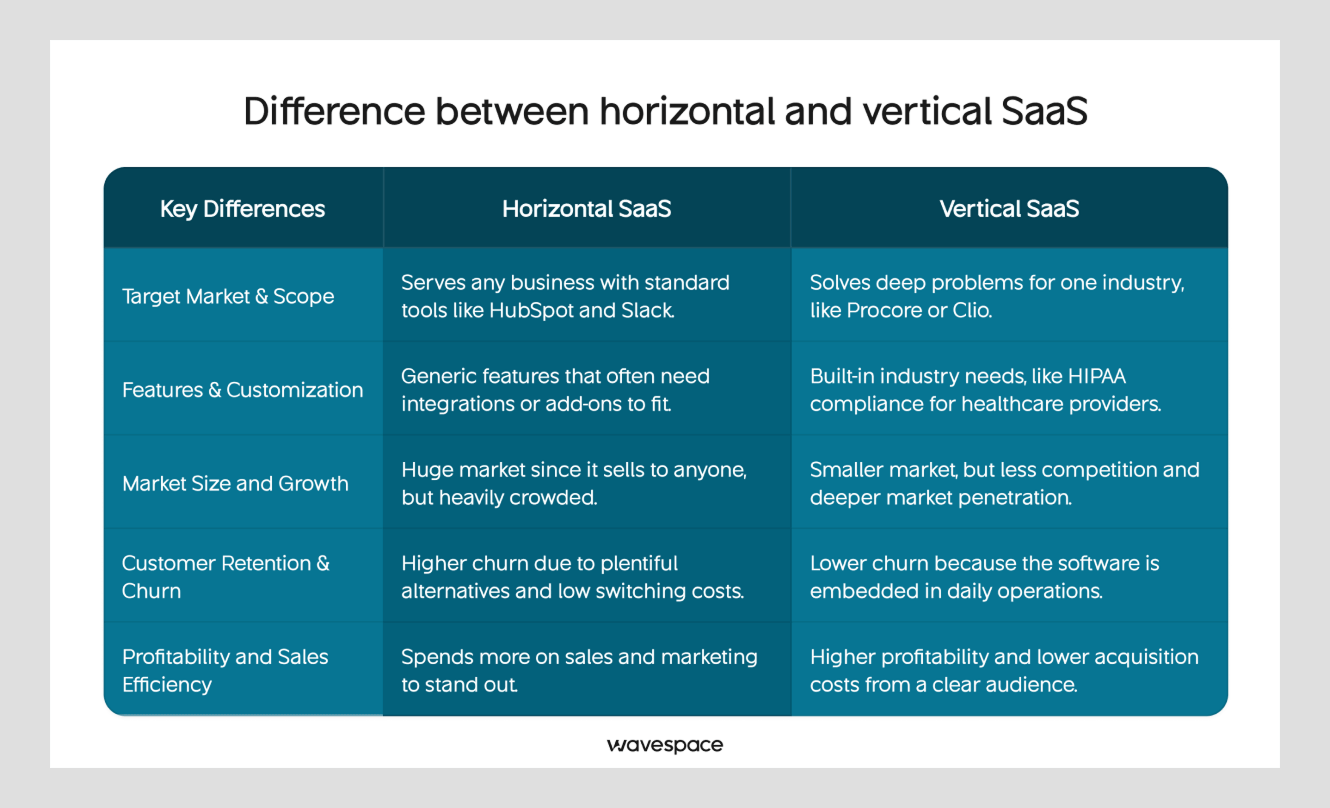
Horizontal SaaS serves many industries with one kind of tool. Slack, Zoom, and HubSpot are horizontal. A bakery and a bank can both use them.
Vertical SaaS serves one industry with many tools. Toast is a strong vertical SaaS example. It gives restaurants ordering, payments, and staff tools in one place.
- Horizontal: a huge market, but tough competition.
- Vertical: a smaller market, but loyal users and less noise.
What is the difference between B2B and B2C SaaS?
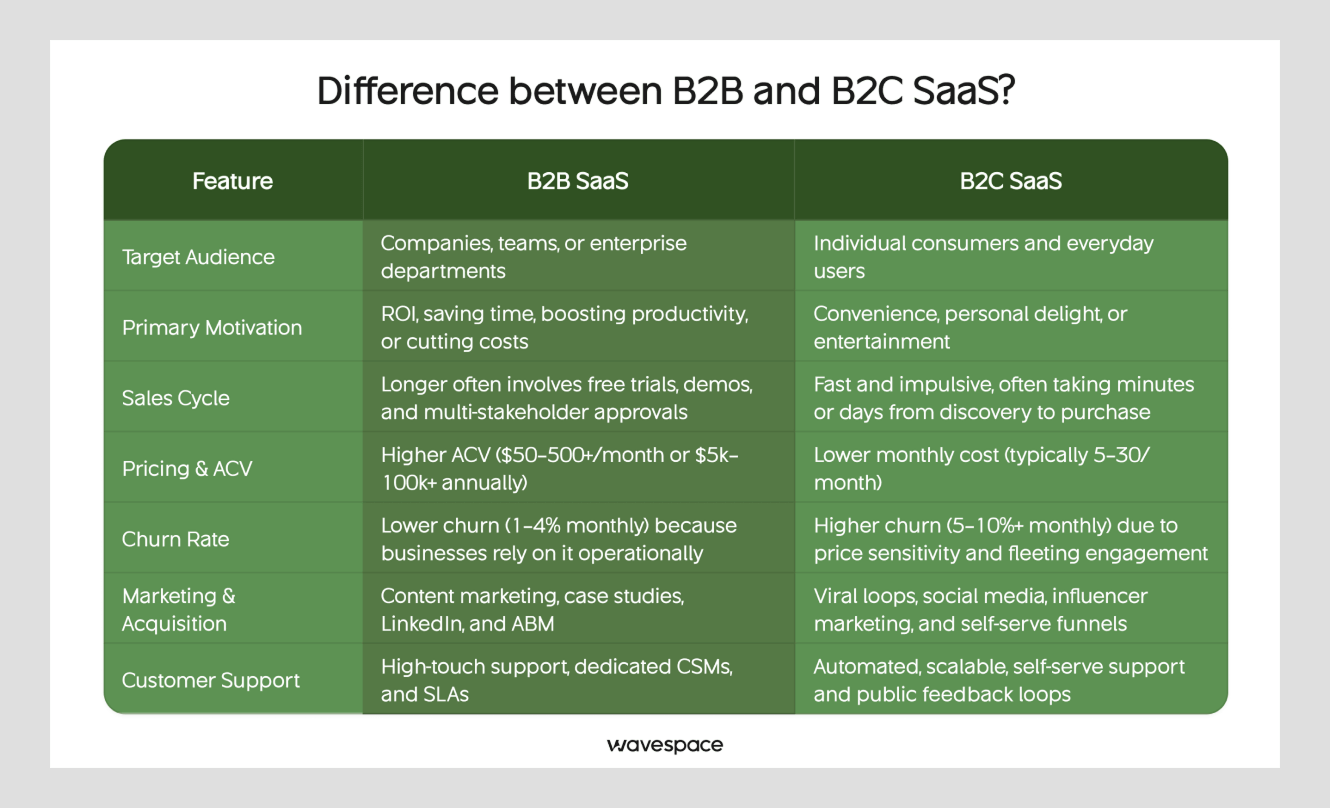
B2B SaaS is business-to-business SaaS. Examples of B2B SaaS companies include Salesforce, Workday, and Jira. Deals are bigger, sales take longer, and several people often need to say yes.
B2C SaaS is for the common man. Examples of B2C SaaS are Grammarly and Dropbox. These products need a lot of users and a seamless sign-up process, which is why plans cost less.
Some products are used on both sides. Canva and Notion began with individual plans and expanded to team plans.
What is the difference between Micro SaaS and Enterprise SaaS?
Micro SaaS is a small product, typically developed by a single founder or a small team. It solves one narrow problem, like a browser plugin or a simple reporting tool.
Enterprise SaaS serves large companies with thousands of users. Enterprise SaaS examples are SAP and ServiceNow. These products require robust security, administrative controls, and dedicated support.
What are the main SaaS pricing models?
- Freemium: A free plan with paid upgrades, like Slack and Zoom.
- Per user (per seat): You pay for each person, like Salesforce.
- Tiered: Bigger plans unlock more features, like HubSpot.
- Usage-based: You pay for what you use, common in AI and data tools.
Your pricing model shapes your design too. A freemium product has to show its value in the first few minutes. If it doesn't, free users never upgrade.
How do you choose the right SaaS for your business?
The right SaaS is not a feature list, it's the right SaaS that meets your team's actual work. So before you buy or build, ask yourself these five questions:
- What problem are we solving? Start with the pain, not the product.
- Will it connect to our current tools? Check for integrations with your CRM, email, and data.
- Can it grow with us? Look at the price when your team doubles.
- Is it secure? Ask about data storage, logins, and compliance.
- Will people actually use it? Test it with real users before you sign.
That last question is the one most teams skip. And it's the one that hurts the most.
Here's what we've learned from 550+ projects: features get a SaaS product bought, but UX gets it used. When a product feels confusing, people quietly drift back to spreadsheets. When it feels clear, they tell their coworkers.
We saw this with ZeroEssay. We reworked their product flows and cut the steps in their core user flows by 60%. Their monthly recurring revenue grew by 120%. Same product idea, clearer experience.
If you're building a SaaS product, this is where we come in. At Wavespace, we design and build SaaS products that users understand from the very first click.
You work with senior designers only, and you see first designs in 4 to 5 days. Book a call with our team to talk through your product.
Frequently asked questions about the types of SaaS

The different types of SaaS fall into two groups. By function, there are CRM, ERP, accounting, project management, communication, HR, marketing, support, analytics, design, e-commerce, security, AI, and vertical tools. By business model, there's horizontal vs vertical, B2B vs B2C, and micro vs enterprise SaaS.
There's no single official number. Most guides list 10 to 15 main categories by function. In this guide, Wavespace covers 14 categories plus three business model pairs.
Well-known SaaS examples include Salesforce, Slack, Zoom, Shopify, Figma, HubSpot, QuickBooks Online, and Google Workspace. Each one runs in the cloud and charges a subscription.
Software counts as SaaS when the provider hosts it, you reach it online, and you pay through a subscription. If you have to install it and run it on your own servers, it's not SaaS.
Yes. Cloud hosting is the key to SaaS. The provider runs the software on its own servers, and you use it over the internet.
Salesforce is a horizontal B2B SaaS solution in the CRM space. It also provides a platform to develop custom applications, which is part of PaaS.

More related blog


Design & development in one team. Let’s talk!














Francisco, CA 94105, United States