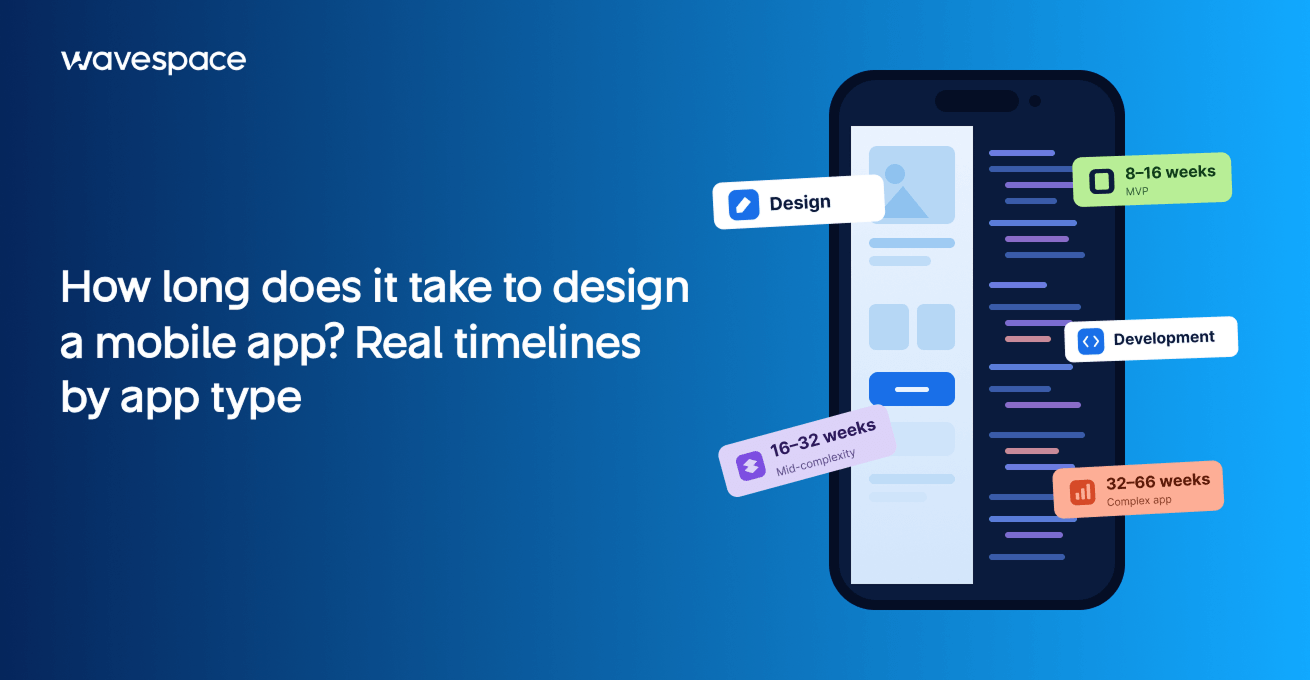
How long does it take to design a mobile app? Real timelines by app type


“The question that keeps founders up at night is, 'How long does mobile app design take?' The real answer is from a few weeks to several months. If an app design agency promises complete design within 2 weeks, you should run the other way.
Because app design is more than just making a good-looking UI UX design, login page, and animated splash screen. A good app design depends on the scope, screen numbers, user flows, platform integrations, and revision cycles.
In this blog, I will tell you how long mobile app design actually takes based on our experience with multiple clients.
How long does it take to design a mobile app?
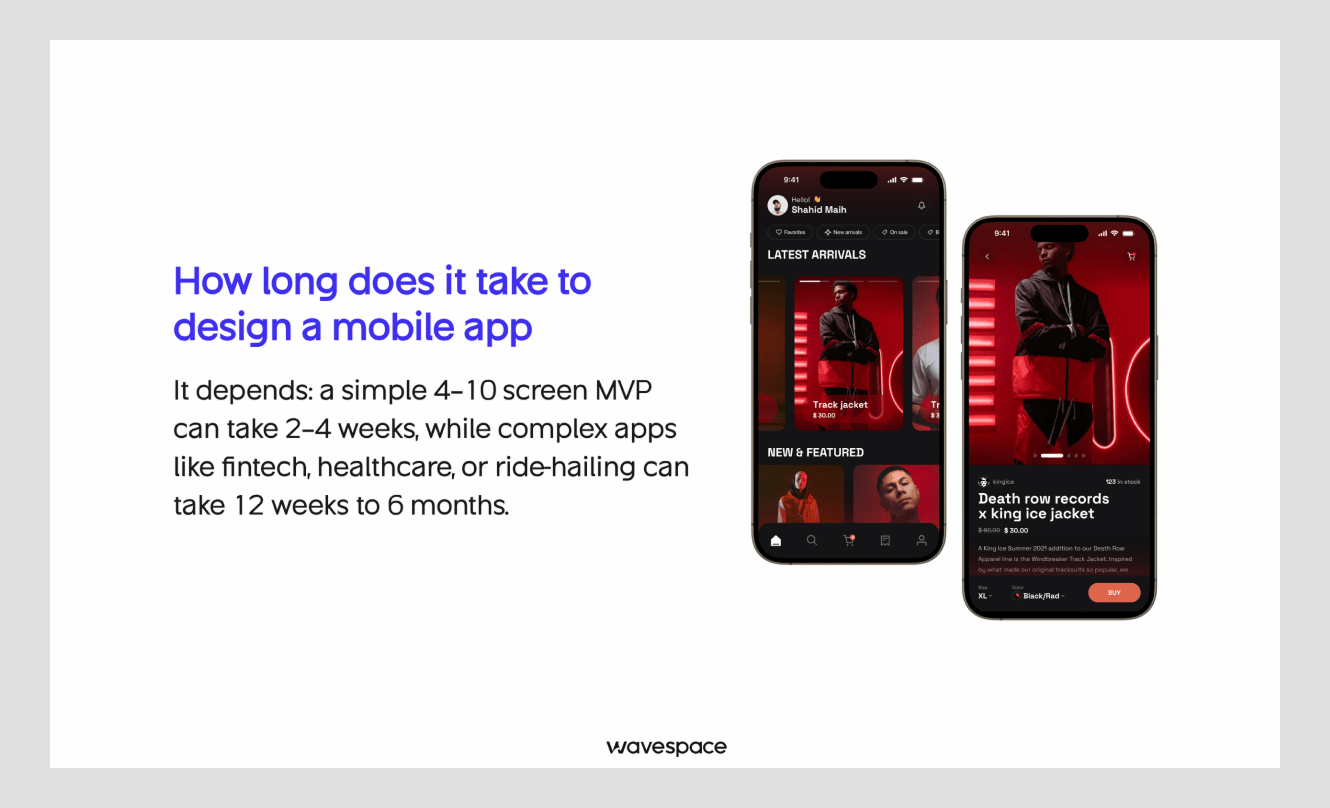
One thing we noticed is that one question, “How Long Does It Take to Design a Mobile App,” comes up in the discussion in the first five minutes of every call. Well, the short answer is "It depends." And the long answer is it depends because a simple MVP with 4-10 screens can easily be designed within two to four weeks.
In a different situation, like a fintech, healthcare, or ride-hailing (e.g., Uber or Lyft) app with compliance requirements, it can take twelve weeks or six months.
This big difference in app design comes from a handful of factors that founders should understand before committing to a launch date for their startups.
I will break down a realistic mobile app design timeline by type, explain what drives the timeline, and provide you with an accurate estimate for your upcoming project.
Mobile app design vs. mobile app development: What's the difference?
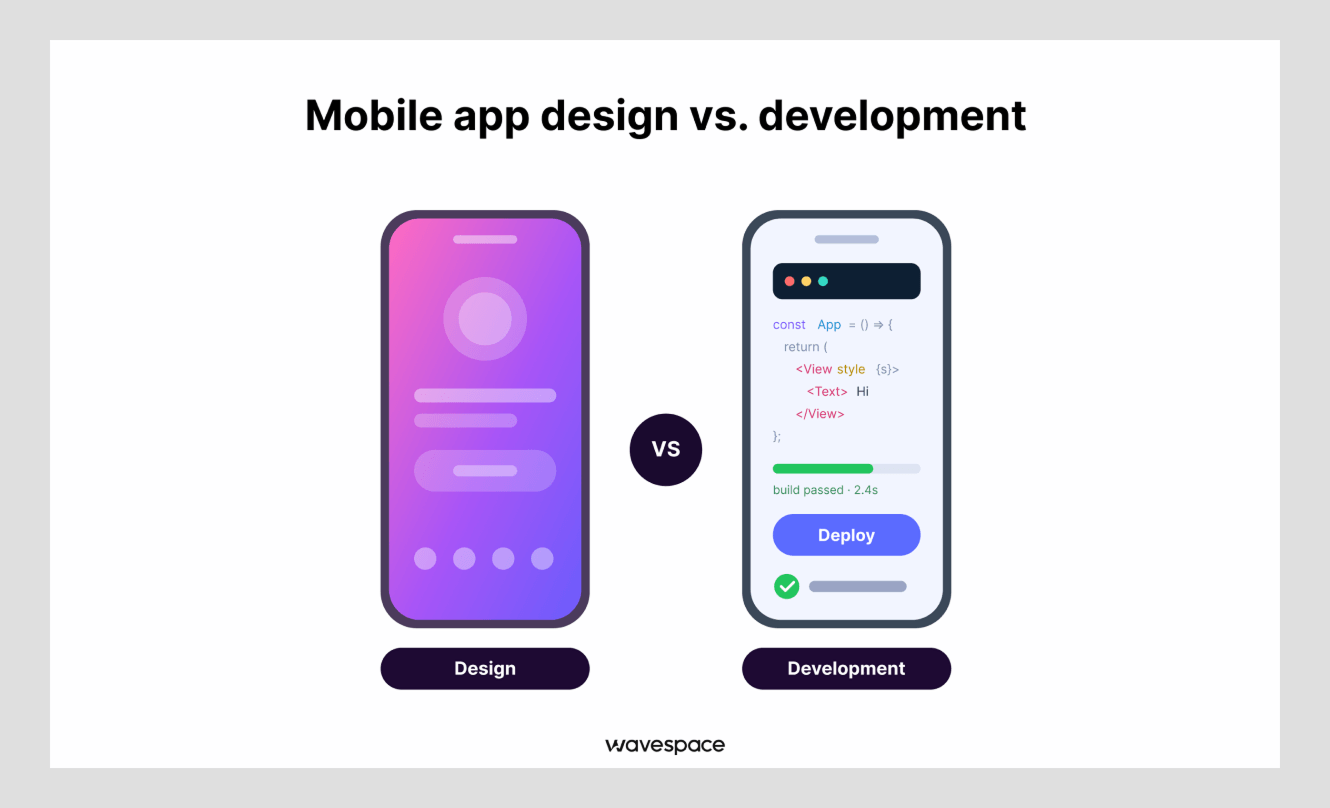
Many people don’t know that designing an app and developing an app are totally different, which is the reason many think app design means a fully functional app. Also, this is the sole reason most get confused about the app design timeline.
But design is a process of figuring out how the app will look through UI and how the app will behave through UX. App UI/UX consists of wireframes, user flows, visual design, prototypes, and a design system that developers use to build the actual app.
On the other hand, app development is writing code that makes the app run on handheld devices. Design and development are intertwined. You need design first to develop an app, and you need development to bring the app to life.
To release an app, you need ideation, design, development, and release. Developers start building the app infrastructure after the first stage of design, while designers finalize later screens. When people ask how long an app takes to build, they usually ask how much time it will take to release the product.
Mobile app design timeline by app type
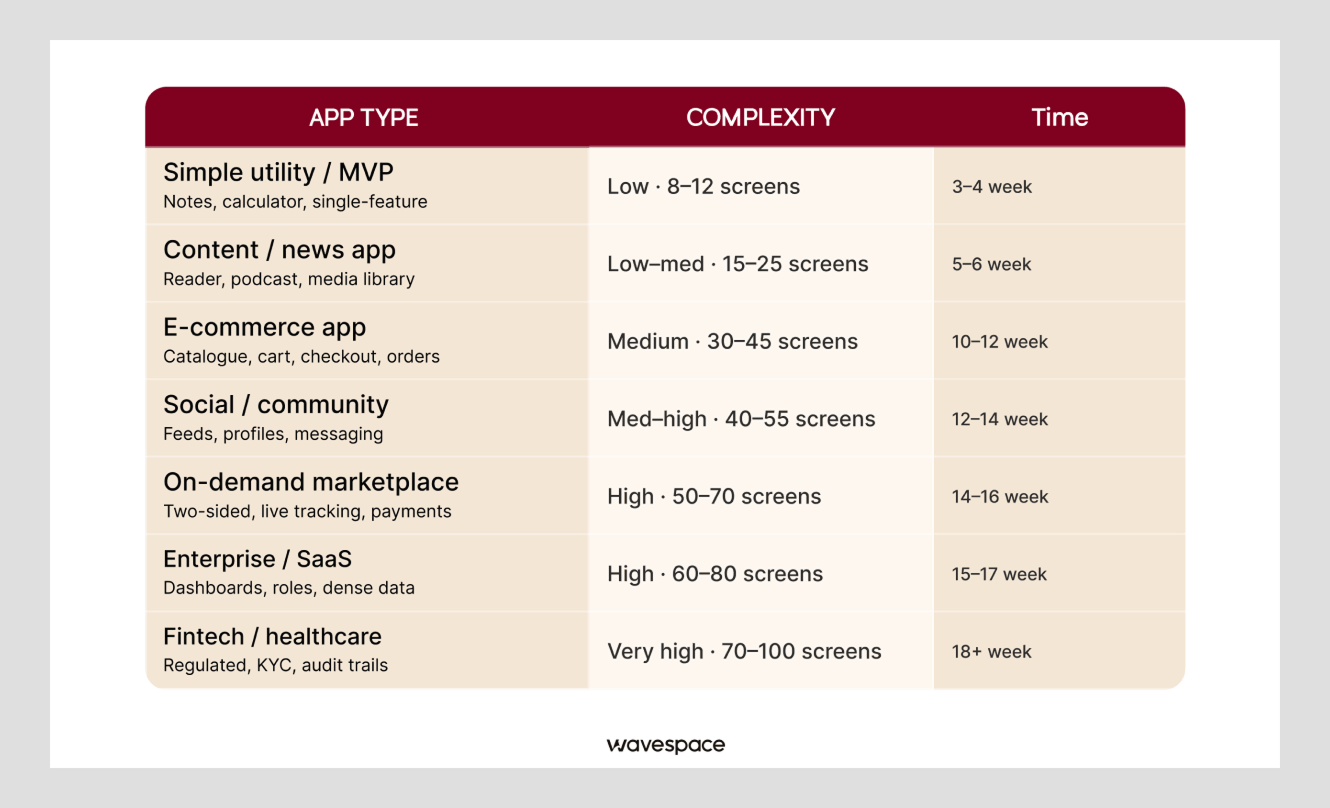
App design timeline depends on multiple factors. It can take from 2 weeks to 6 months depending on the scope and type of mobile app. These ranges can also fluctuate based on the number of designers actively working on the project. Also consider the weeks between feedback rounds, turnaround time, and approvals.
Simple MVP app (2–4 weeks)
A simple MVP app to check whether an idea sticks or not takes around (2–4 weeks) a month. These MVP app designs don’t come with design complexity; instead, they rely on simplicity.
They take the least time because they have only one core user flow and a handful of screens that can be easily designed after the initial design is set.
Note that this is not a full app. It’s a single-purpose utility app for early-stage startups to test one idea before raising money from investors or going into full development. The goal of an MVP app is not to have a polished app. It works as a proof of concept that looks credible and is enough for investors or early users to get invested.
Business / service app (4–8 weeks)
Business apps are service or support apps for businesses. Not every business needs an app, but some businesses need an app for scheduling, a loyalty app, or an internal ops tool. Business or service apps usually take 4 to 8 weeks.
These apps take more weeks than MVP apps because a service app can have more than 5 core flows and more screens than an MVP. These screens are authentication (sign up, log in), profile, home screen, and admin views plus customer-facing screens.

E-commerce app (5–10 weeks)
An e-commerce app takes 5–10 weeks because the design work for e-commerce is real. Mobile app designers have to design multiple user flows for a single app. It typically requires 40 to 80 unique screens to cover the complete user journey from browsing to post-purchase.
These screens include product listings, cart, checkout, payment states, order history, search, filtering, delivery screens, profile, and more. An e-commerce app requires careful attention to design. Our e-commerce design for Off-White took a total of 3 months from the discovery call to delivery.
Booking / Travel app (5–9 weeks)
Booking apps take as long as 3 months, as much as an e-commerce app, because their success depends on the search and reservation flow.
Booking or travel apps need to nail calendars, availability logic, advanced filters, confirmations, and, moreover, the app has to support map or location components.
Close to 3 months or 5 to 9 weeks is typical for this type of app. You should also reserve 2–4 extra weeks if the app handles multiple booking types (flights and hotels in one app).
Fintech app (8–14 weeks)
Fintech, money, or banking apps UX take longer time to design than any other apps above. Because fintech and banking apps have higher stakes and more complex compliance requirements than e-commerce products.
Fintech apps have more complex flows like KYC, verification, transaction histories, security, and error states for failed transfers. The realistic range for designing a fintech app is 8 to 14 weeks. Which directly impacts the overall fintech app design and development cost. That's before the legal and compliance review.
Healthcare app (8–16 weeks)
Healthcare app design takes the most time of any app design. Medical apps strictly follow regulatory requirements like HIPAA.
HIPAA is a set of U.S. laws that protects people’s health information and sets rules for how it can be used and shared. Health apps have to abide by HIPAA in the U.S., GDPR in Europe, and PDPL and SDAIA for Middle Eastern countries.
Medical apps usually take 2 to 4 months for designers to finish the design. With multiple user types (patients, providers, sometimes caregivers or admins), each needs their own experience. However, it can take additional weeks if your project involves telehealth or clinical data.

SaaS / Productivity app (6–12 weeks)
SaaS products typically take 8 to 12 weeks. However, startup SaaS apps take less than 2 months. The timeline of SaaS app design varies based on screens, complexity, and size of user base.
SaaS designs include dashboards, settings, screens for different user roles, and the use cases around permissions. Design time can take longer when you need permission levels for every role. However, most of our SaaS app designs are done within 8-10 weeks.
Social media app (8–16+ weeks)
The initial design of social media takes around 8–16 weeks. However, social media app design is not a one-time thing. Social media companies tend to have in-house designers to polish and make updates to the design every day.
Because social media apps have multiple flows in a single app. Feeds, profiles, messaging, notifications, content creation tools, and moderation states.
Social apps need dedicated designers because the app needs to be prepared for 24/7 and consider the fact that users scroll social media for hours. The best way to design a social media app is to hire a design agency for design work and subscribe to a dedicated designer plan to work on.
Enterprise app (0–20+ weeks)
Enterprise products, specifically enterprise apps, take the longest time to design, not because of regulatory requirements or strict laws, but because enterprises have many stakeholders and integrations with existing internal systems and hundreds of roles.
Designers have to sit through multiple rounds of review and interviews with stakeholders across departments before a screen is considered final. Ten to twenty weeks for enterprise apps or more than normal.
What actually determines mobile app design time?
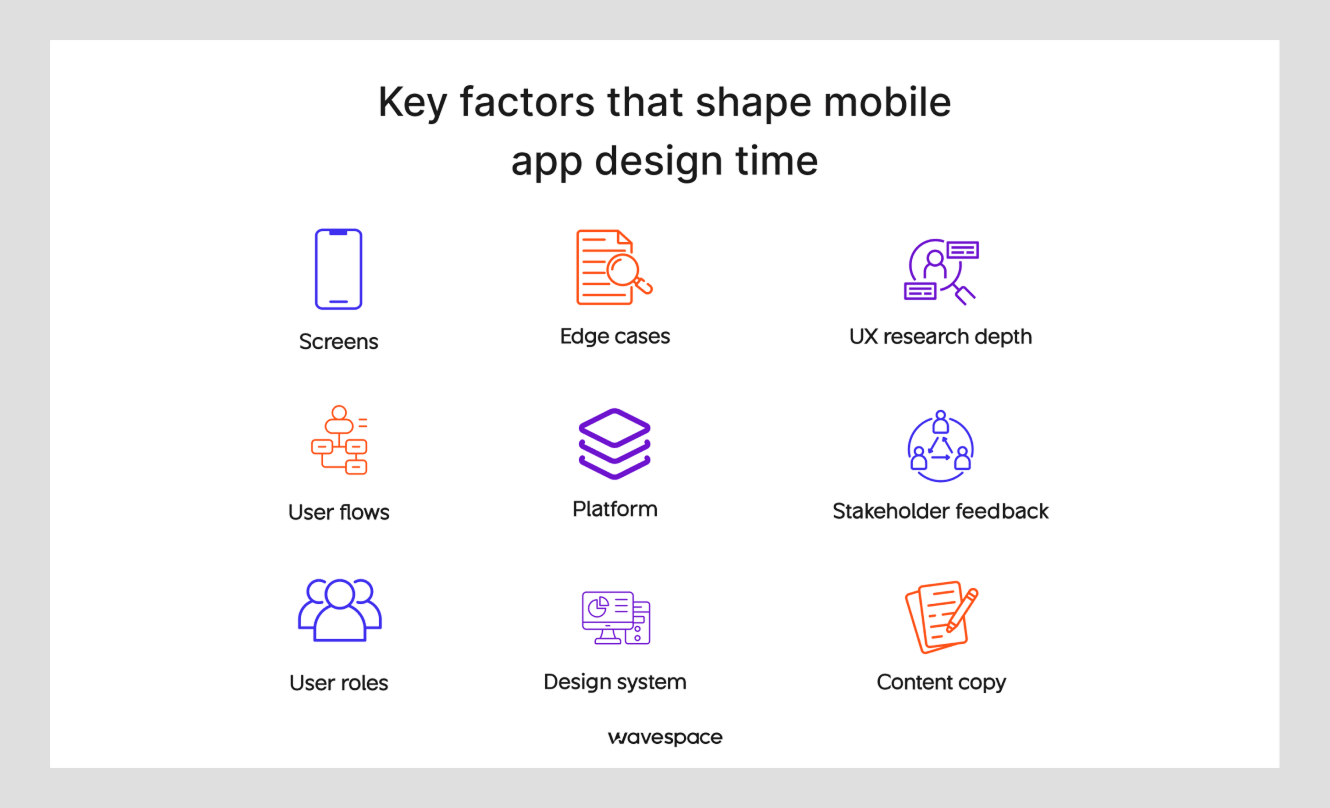
The average range of different types of app designs is just the starting point. But the real answer to “How long app design takes” comes from multiple factors discussed below.
Factor 1: Number of screens
Screens and flows are the core reason that determines the timeline of app design. More screens mean longer times. Fewer screens mean less time. A simple MVP takes around 2–4 weeks, but slap on more screens, and designers will need extra weeks to finish product design.
Founders should know that fewer screens don't mean quicker delivery. You have to count screens by effort, not by quantity. Ten simple screens (a settings page, a static list, a confirmation screen) require fewer than ten complex screens (a dashboard with filters, a multi-step checkout, an interactive map).
Factor 2: Number of user flows
The number of user flows is also a major factor in the app design timeline. A screen can have more than one flow, and designers design each flow with its own logic.
An authentication flow can have multiple screens. App designers spend the initial phase finalizing how the app will look; after that, designers spend most of their time designing flows. Each one needs its own attention to edge cases and error states.
Common app design flows
Onboarding flow:
- Splash screen → Welcome → Sign up/Login → Permissions → Preferences → Home
Authentication flow:
- Login → Enter credentials → Verification/OTP → Success → Home
- Forgot password → Email/OTP → New password → Login
Navigation flow:
- Home → Search → Category → Detail → Action
- Home → Profile → Settings → Account
Core task/user flow:
- Home → Select item → Configure → Review → Confirm → Success
Factor 3: User roles
An app with fewer user roles takes less time to design. One type of user (customer) is simpler to design, and an app with three user roles (customers, staff, and admins) is more complex. And each of the roles often needs its own version of shared screens and a specific screen for itself.
Factor 4: Edge cases
The number of screens is not only about user flow and roles but also about edge cases. Edge cases are the unprecedented situations that happen rarely. App designers have to design screens for these scenarios.
They have to think about when the cart returns empty, payments fail to go through, or the user faces a network issue mid-operation. These states are not considered in the initial screen count but take time to design.
Factor 5: Platform
The platform is another factor of app design. App design will take longer if you design for multiple platforms like iOS and Android. However, designing apps solely for iOS is much faster than for Android.
iOS app design is faster because iPhones have fewer screen sizes. Furthermore, Apple's HIG (Human Interface Guidelines) provides designers with clear guidelines for UI and UX design decisions. These strict rules help to bring the design time down compared to Android.
Factor 6: Design system
Designers can jump into your app design if you have a pre-existing design system. Building a design system from scratch takes a significant amount of time, but it is done to save time later. An existing design system helps designers with its predefined components, colors, and typography. With an app, a design team can start without losing time ideating design choices.
Factor 7: UX research depth
UX research is another factor that decides the length of the timeline of design. At our design agency, we start putting focus on research first. Well-conducted research helps designers understand what results our clients are looking for.
We start UX research with competitors, interview users/stakeholders, and conduct usability testing. Strategic visual decisions, such as color psychology in green app UX or red app UX, are also established during this stage.
After that, our designer starts the design process to bring the best outcome that aligns and is beneficial for our client. Skipping research can shave off some time from design. But most of the time it backfires by increasing the budget and delaying delivery.
Factor 8: Stakeholder feedback
Stakeholder feedback is the most underestimated factor by clients. Quick stakeholder decisions make design fast. A client who reviews and provides feedback in a day helps designers make adjustments quickly. But a client who takes weeks for review and feedback makes the entire process longer.
Factor 9: Content copy
Designers need real copy to finish the design. They design mobile apps with placeholder images and copy that looks good enough, but for mobile app development, you need real copy that engineers can paste into the product that will go live.
Many mobile app design agencies like us (Wavespace) provide SEO-driven copywriting services that come along with the design subscription plan.
Real mobile app design timeline example
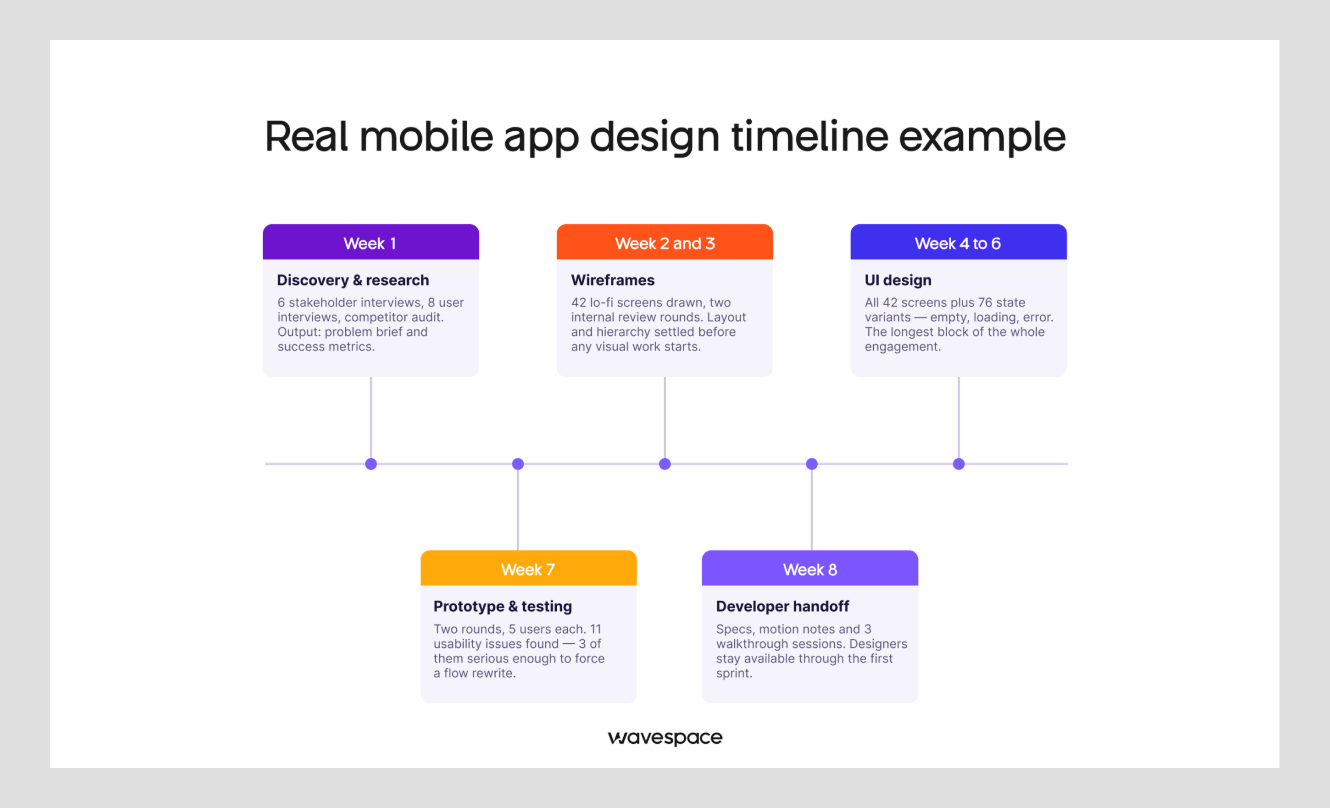
Here's how a SaaS app design project might actually look:
Week 1 - Research and discovery: In the first week, the design team usually spends time creating a mood board, conducting stakeholder interviews, performing competitor analysis, and defining core user flows.
Weeks 2 and 3 - Wireframing: The team spends the second and third weeks designing low-fidelity layouts for every screen in the mobile app scope. Gets them reviewed and revised by the client.
Weeks 4 to 6 - High-fidelity visual design: Design goes to full product. Multiple designers and roles start working to design the mobile. This is the design sprint that goes screen by screen, including the design system components.
Week 7 - Prototyping: Designers make a prototype by connecting screens into a clickable flow for stakeholder walkthroughs and a few rounds of user testing.
Week 8 - Final revisions and handoff: Designers complete the final revision and prepare the files, design system, and instructions for development as part of the final deal.
That's the realistic mobile app design 8-week timeline. However, in practice, some apps might require less time and some more weeks to get things done. The timeline can change based on feedback delays or late requirements.
Can you design a mobile app in 2 weeks?
Yes, but a handful of things have to stay aligned for that. It is doable if your project is a simple 4–8 screen MVP app with minimal flows and an already built design system. Plus, a client who provides feedback for revision on the same day.
However, this is not rushing. It’s narrowing the scope and making it easier for the designer to complete the design. You have to consider that 2 weeks is not a realistic timeline for designing a good mobile app. But it’s not new; we’ve designed an entire SaaS app and made it investor ready within a month.
Mobile app design timeline vs. app development timeline
Mobile app design and full app development have different timelines. However, the app development timeline depends on the design timeline. Developers need the finalized app designs to begin development.
On the other hand, the design process does not depend on the development process and can be completed without them.
A daily-use SaaS app with 35+ screens usually takes 3 to 4 months for its design. After that, development can take around 3-6 months. Enterprise and healthcare projects may take longer due to their additional complexity and requirements.
Final takeaway
There's no definitive answer to "How long does app design take" because different types of apps take different durations. Also, it is shaped by scope, screens, flows, and how quickly stakeholders make decisions.
A lean MVP can be investor-ready in a few weeks, while a regulated fintech or healthcare product can take up to 2–6 months before starting development.
Founders who understand this prioritize a clear scope and believe in a fast feedback loop process. Prepare their project timelines earlier. With that said, mobile app design is not about designing screens fast, because chasing the fastest possible timeline doesn't produce a good app design, but setting a realistic one does.
FAQ of mobile app design

App design is the process of creating the mobile app interface. The mobile app design process includes discovery and research, strategy and definition, wireframing and mood boarding, prototyping and interaction design, and lastly, testing and iteratio
App development is a process where developers build the app to make it usable and publish it as release-ready. The mobile app development comes right after the app design process. The app development process consists of strategy and discovery, planning, UI/UX design, development, testing, deployment, and maintenance processes.
A simple to-do app can be done in 1 month. But other types of apps can take more time. Creating an app refers to building an app, and building an app consists of app UI UX design and app development. A mobile app, depending on the complexity and scope, can take from 4 weeks to 6 months. But on average an app takes two months. Development comes after the design, and it could take somewhere between 2 and 6 months. This also depends on the scope and complexity of the app. A realistic timeline for a banking app is 3–18 months, and a lifestyle app could take 4–6 months.
Yes, owning an app can be profitable if the app sticks with its users. Owning an app has become a side hustle for many. But how much profit you will make is not guaranteed. Most released apps struggle to sustain themselves after 6 months. Success depends heavily on niche, monetization model, and marketing.
If you are wondering how much does it cost to design an app, a simple app can cost $5,000 to design, and a complex app can take $15,000 to $50,000 just for designing. Wavespace offers mobile app service from $2,200 (monthly, 55 hours).

More related blog

Have a Project? Let’s talk!







.png)



Francisco, CA 94105, United States





































.avif)