Top 10 UX Research Agencies to Hire in 2026



Top 10 best UX research agencies to hire in 2026
Looking for a UX research agency in 2026? For digital products, it's more important to create the right thing than a quick one. But many founders jump into development without really understanding their users. Then, realize the mistakes post-launch; users are facing friction, churn, or poor adoption. This is the place where UX research becomes a competitive advantage, not a luxury word.
UX research assists in discovering the needs of their users. Their behaviour and how they come to decisions, and minimize product risk. All-around saves development expenses by making sure each feature solves a real user problem. Leveraging a UX research partner to make your product a success. Whether you want to validate a potential idea during the pre-seed phase or scale an existing product.
In this blog, we drill down on the meaning of true UX research. The importance of UX research for every type of business, and how to choose the right research partner.
We have compiled a list of the 10 best UX research agencies that you need to know. Including agencies that understand your needs, how to work with speed, with uncertainty, and the high stakes of early product decisions.
What is UX research?
UX Research (User Experience Research) is a study of user behavior, their needs, and motivations. UX research focuses on how a service is being used. It identifies the product's frictions and limitations for daily users, and actively finds solutions to resolve them.
It is often confused with User Testing. However, the research runs much deeper than testing. It’s a scientific discipline that uses anthropology, psychology, and data science to research.
The UX research process includes understanding the user environment (where, when, and how users interact with the product). User motives (unspoken reasons behind user behavior). User’s mental model (how users think things should work based on their past experiences).
In short, UX Research (UXR) studies what users want to do and how they accomplish it.
UX research vs UI design vs Product research
Many mistakenly believe UXR is a prepackaged part of UI Design. That is incorrect. They are both different in nature.
- UX research: Focuses on user expectations, usage behaviors, and overall satisfaction. Makes it easy.
- UI design: Mainly focuses on visual and interactive design elements of a product. Makes it attractive.
- Product research: Covers trends, market requirements, competitor analysis, and viability, often overlapping with UX research.
A strong UX research approach ensures your product isn’t just beautiful. But also usable and meaningful for real users.

Why invest in UX research services
Many treat UX research as an afterthought. “Release now, we will fix issues as they come.” But the digital scene shows something totally different. Releasing a product that ignores the user's comfort level/need leads to churn and loss of market share.
Experts at Wavespace advise consulting with a UX agency before starting to build. Without proper UX guidance, a great idea can fall into irrelevance.
1. The ROI of experience
The financial return on UX investment is among the highest of any other business activity.
- Conversion increase: Designing checkout for user comfort or optimizing can significantly boost conversion rates (Wavespace has increased $114 ROI for every $1 invested).
- Reduced development waste: Phil Koopman of Carnegie Mellon University has found that 40 to 50% of engineering time is spent on changing. Which could be avoided with research. UX Research Services ensures developers build what works on the first go.
- Customer retention: 88% of users don't return after a bad user experience. In the SaaS world, where acquisition costs are high, churn is a death blow.
2. Psychology of trust
Research has found that trust is a barrier. It takes a lot of time and effort to gain, but you can lose it in a matter of seconds. Around 32% of customers stop doing business after a negative experience. If a Fintech app has a confusing login. Users will assume their life savings are not safe. Research uncovers these hidden trust barriers.
Why hire a UX research agency in 2026
Most product teams skip research until something goes wrong or breaks. A feature launches, users drop, and nobody can explain why. That's when research becomes an urgent matter.
A dedicated UX research agency gives you answers before that happens. They run usability studies, interview real users, and analyze behavioral data. Not just as a side task in between sprint tickets, but as serious work. This specialization matters for products.
In 2026, the cost of guessing is higher. Low-quality interfaces are everywhere, users have more options on their disposal, and switching friction is as low as it can be.
A session with just five real users can dig out the problems that six months of analytics can't. UX research agencies bring that workflow, recruiting, screeners, synthesis tools, and report formats.
Practical case: UX agencies cost less than building an in-house research team, and it comes with the flexibility of scaling researchers up or down whenever you need.
Top 10 best UX research agencies - Quick comparison
Top 10 best UX research agencies for startups
1. Wavespace
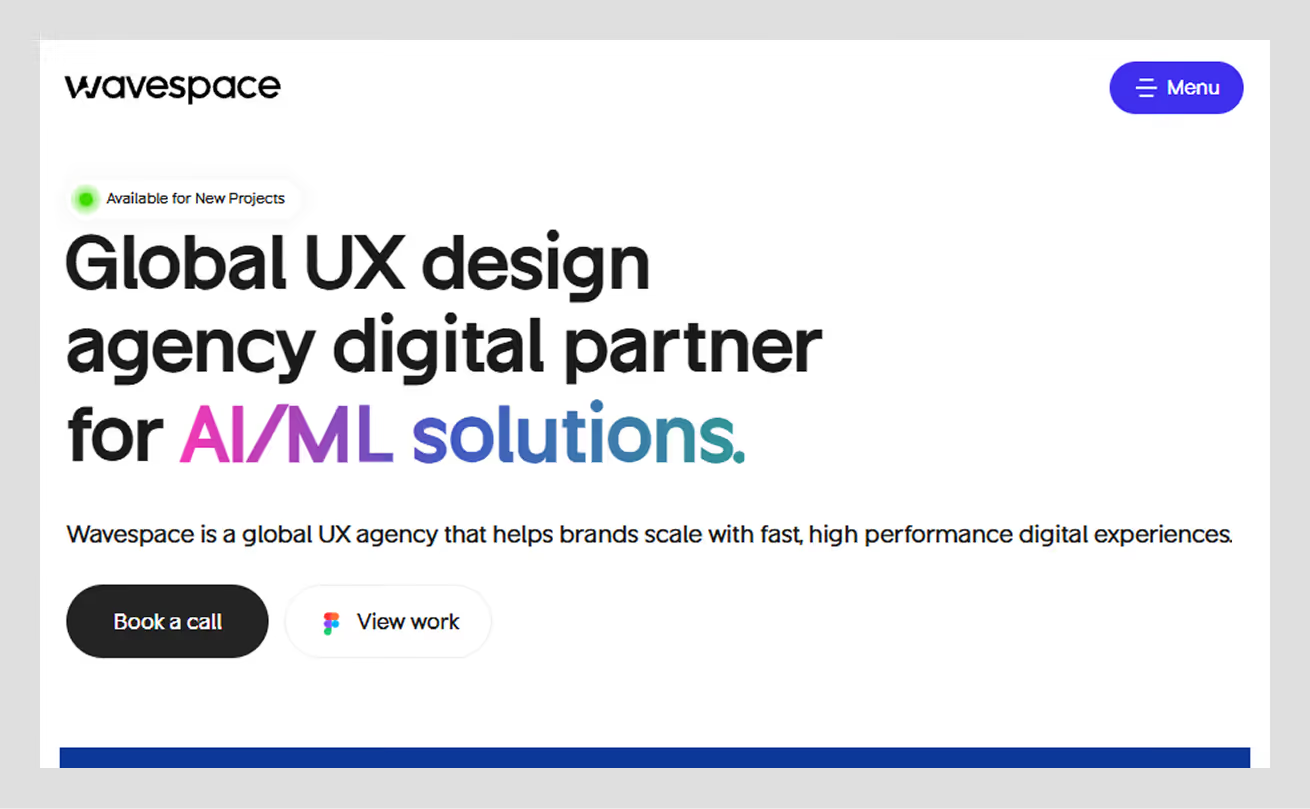
Wavespace is a product-oriented UX research and strategy firm. Specialized in assisting brands and digital teams, ensuring the product shines in a competitive setting. Wavespace implements UX research as a practical decision-making tool.
They don't consider research as a final report. Their team works closely with product strategy, prioritization, and execution.
Their strategy is both academic and entrepreneurial. Wavespace focuses on just enough research to make the product better. Done at the right time, to reduce risk without slowing teams down. This is effective when the start-ups are trying to achieve product-market fit. Or are unsure of what to develop next, even in the case of strategic turns.
Wavespace collaborates with startup founders, product managers, and designers, unlike the traditional research-only firms. This partnership makes insights an effective product direction. Their work is not only about usability fixes. But also, tends to influence roadmap, MVP scope, and go-to-market decisions.
They are a strong candidate when a startup has limited time, budget, and resources. Additionally, there is a need to know what to build next and why.
General overview
- What they are: A UX research and product strategy agency focused on decision-driven research.
- What they do: Connect user research directly to product strategy. Help teams validate ideas, reduce risk, and align stakeholders.
- Best for: Early-stage and growth-stage startups. Startups in Fintech, SaaS. Product facing uncertainty or complex product decisions.
- Known for: Research-to-decision frameworks. Founder collaboration. Clear, actionable insights that influence product direction.
- Research methods: User interviews. Problem discovery research. Concept and MVP validation. Usability testing. JTBD analysis. Opportunity mapping.
- Pricing:
- Flexible subscription and project pricing.
- Perfect for agile teams.
2. Nielsen Norman Group

Nielsen Norman Group, or NN/g, is widely known as the world’s leading wave makers on UX. Founded by UX pioneers Don Norman and Jakob Nielsen. NN/g focuses on evidence-based research rather than subjective design trends.
NN/g provides a foundational level of scientific rigor that is rare in the agency world. They don't just check a design to ensure the product is intuitive. They apply decades of cognitive psychology and human-computer interaction (HCI). Their work often centers on high-level consulting and training.
This way, they help brands establish their own foundation and improve UX. NN/g is a research-first organization that provides unbiased audits. So it can validate a product concept before a single line of code is written. Minimizing the risk of the development process for founders and investors alike.
General overview:
- What they are: Prestigious UX research and training consultancy.
- What they do: High-level audits with expert review. Specialized UX training for teams.
- Best for: Products with complex architectures. Needing to scale at a large level. Expert validation for investors.
- Known for: Heuristic Evaluation, UX certification, and foundational whitepapers on user behavior.
- Research methods: Heuristic Evaluation. Eye tracking, Field research. Quantitative usability benchmarking.
- Pricing:
- Premium enterprise consulting fees.
- Best for high-stakes validation.
3. AnswerLab

AnswerLab is a research-only agency. They help ambitious brands and high-growth startups looking to scale their user insights. AnswerLab focuses uniquely and tries to understand the why behind user behavior.
They are good at helping growth-stage companies navigate the messy middle of product growth. Uncovers the drop-off reason and user friction, which helps to deliver real value. AnswerLab provides strategic direction through clear, actionable roadmaps, rather than just research findings.
AnswerLab can run global studies quickly and reliably with a large internal team of experienced moderators and researchers. This makes them a strong partner for companies expanding into international markets.
General overview:
- What they are: A dedicated user research and experience strategy firm.
- What they do: Design and execute research results. Finds user motivations and friction.
- Best for: Growth-stage startups. Products need to outsource large-scale research.
- Known for: Strategic UX insights. Specialized research in AI & Accessibility.
- Research methods: Remote usability testing. Diary studies. Card sorting. Stakeholder Interviews. Persona research.
- Pricing:
- Custom project-based pricing models.
- Built for scaling large studies.
4. Adam Fard Studio
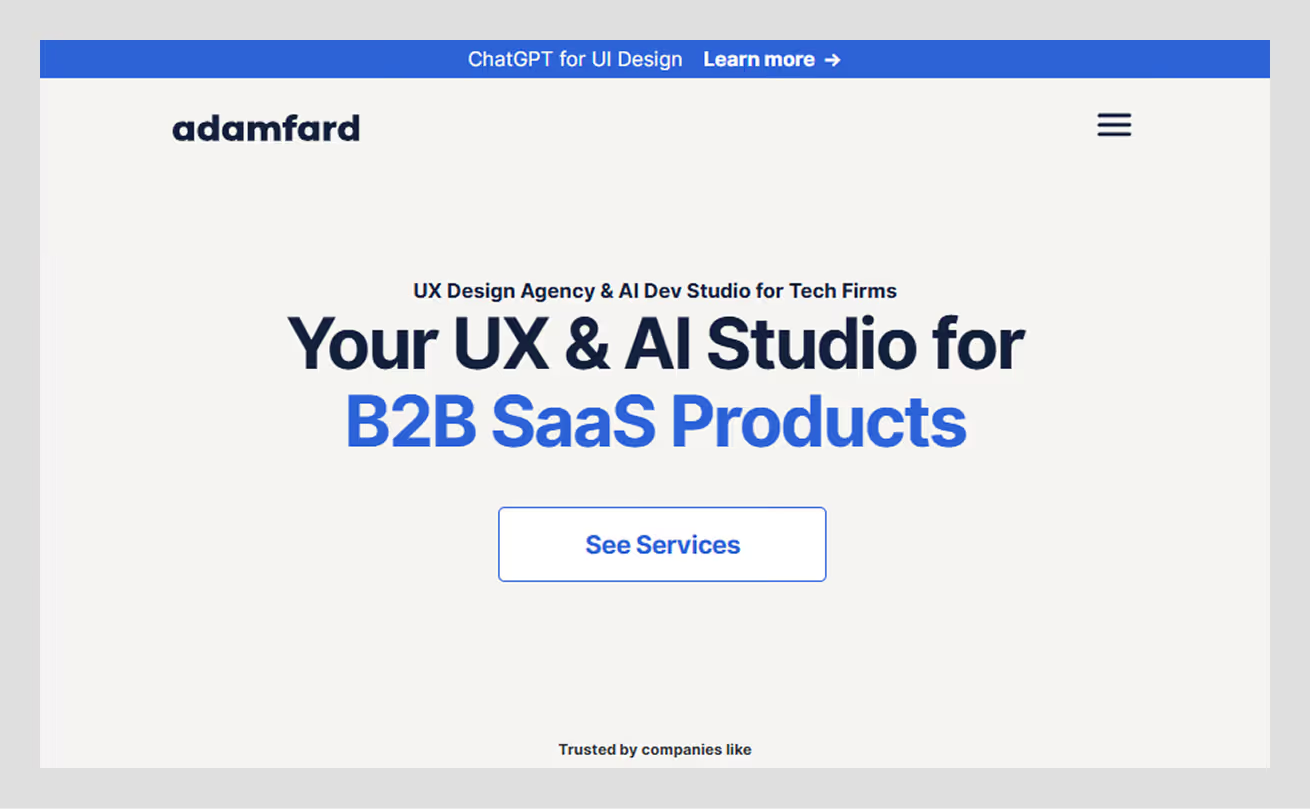
Adam Fard Studio is a small UX agency. Works mainly with SaaS, Fintech, and EdTech. They strongly believe UX is not just about looks. It is a powerful tool that helps businesses grow.
Their research focuses on keeping users longer and reducing churn rate. They use Lean Research. Their approach is fast, agile development. This means research supports the team instead of slowing it down.
Adam Fard Studio is good for improving complex B2B software. Works for products/services that get results but feel confusing. And turns them into clean, easy-to-use experiences. Their work often moves straight from research into high-quality design prototypes.
General overview:
- What they are: A data-driven UX and UI design agency. Focuses on complex B2B products.
- What they do: Review products. Talk to users. Test designs to make SaaS products easier.
- Best for: SaaS and Fintech startups. Needing to simplify complex products.
- Known for: SaaS UX design. Enterprise dashboards. UX audits.
- Research methods: UX Audits. User Interviews. Competitor Analysis. Customer Journey Mapping. Information Architecture Testing.
- Pricing:
- Competitive hourly and fixed rates.
- Focuses on improving business metrics.

5. Blink UX
Blink UX is a research-first design firm. Founded on the idea of Evidence-Based Design. They have over 20 years of experience. They have one of the most advanced research labs in their arsenal. They focus on testing from mobile apps to physical devices and VR headsets.
For every type of business stage, Blink UX brings a strict methodology and precision. Their research helps teams make design decisions backed by real evidence. They don't believe in guesswork. They are especially strong at Discovery Research. It helps companies understand how users think before building a product.
Their approach is highly collaborative. Often, startup founders join research sessions to understand the users better. By leveraging evidence, they focus on helping brands avoid founder bias and on what users really need.
General overview:
- What they are: A full-service design firm, a strategy and UX researcher.
- What they do: Combines deep user research with high-quality design. Assists in creating products based on real evidence.
- Best for: Companies looking for partners to work in Healthcare, Biotech, or Hardware.
- Known for: Evidence-based design. Advanced research labs. Complex ecosystem strategy.
- Research methods: Contextual inquiry. Benchmark studies. Physiological testing (AR/VR). Diary studies. Usability labs.
- Pricing:
- Premium time-and-materials rates.
- Perfect for complex hardware testing.
6. UX Studio

UX Studio is a fast-moving European UX agency. UX Studio uses a high-speed, iterative approach; they believe many companies don’t have the time or budget for long research projects.
Their method is very practical; they work closely with brands. Their teams of researchers and designers work as full dedicated team members of client projects. This ensures a complete understanding of the product’s market and users. UX Studio aims to find quick ways to improve conversion and retention.
They're transparent and collaborative. Often works on a weekly feedback loop. They utilise the fail-fast technique. This way, UX Studio can start testing on Monday and provide feedback by Friday.
General overview:
- What they are: A flexible, research-driven design agency.
- What they do: Provide dedicated UX teams to handle everything for user research.
- Best for: Brands looking for a full-time UX partner without hiring a permanent team.
- Known for: B2B SaaS. Weekly research cycles. Transparent project management.
- Research methods: Rapid usability testing. Field research. Onboarding audits. Concept validation.
- Pricing:
- Monthly fee for dedicated teams.
- Integrates fully with dev sprints.
7. Momentum Design Lab

Momentum Design Lab is a global product innovation (designing the future) agency. They help companies transform their products by taking a basic MVP and turning it into a market-leading platform.
Their research focuses on Cognitive Design. It looks from the user's perspective of a product, how it looks, processes its information, and makes their decisions. This is especially useful for data-heavy products, such as Fintech or AI.
Momentum takes a holistic approach. They don’t just focus on the screen; they look at the complete business ecosystem. They focus on helping with product strategy, service design, technical feasibility, and user experience.
General overview:
- What they are: A global product innovation agency.
- What they do: Combines user research, product strategy, and technical design.
- Best for: Fintech, AI, or other tech-heavy industries.
- Known for: Cognitive design. Product transformation. Solutions for innovative technologies. Holistic approach for business and UX.
- Research methods: User research & Cognitive testing. Market & Competitive analysis. Service design & Product strategy. Technical feasibility studies.
- Pricing:
- Strategic innovation-tier pricing.
- Best for total product overhauls.
8. Loop UX

Loop UX is a global research agency. They specialize in fieldwork and international studies. Many look for someone to test their products with local users. Loop UX solves this by giving access to a worldwide network of researchers.
They mainly handle tricky logistics, including recruiting participants, moderating in local languages, and analyzing cultural differences. Their research helps to understand how products work across different cultures. This research finds answers to questions of why some products work in the USA but fail in Europe.
Loop UX is a full-service research agency. They focus on taking care of everything from the initial stage to delivering the final report. This method lets founders build their product while getting global user insights.
General overview:
- What they are: Full-service international UX research agency.
- What they do: Run localized user research around the globe.
- Best for: Companies want to expand internationally. Established product looking to expand.
- Known for: Global fieldwork. Expert moderation. High-quality participant recruitment.
- Research methods: Ethnographic field studies. Global focus groups. Participatory design. Remote in-depth interviews.
- Pricing:
- Variable global fieldwork costs.
- Essential for international expansion.
9. Halo Lab
Halo Lab is an award-winning design and development agency. That mainly combines beautiful design with user research. Unlike other creative agencies that are concentrated on looks, Halo Lab uses research to guide every design decision.
They help brands build“Launch-Ready” products that are not only visually appealing but also backed by proof. Their research focuses on conversion optimization, finding what makes users click “Sign Up” or “Buy.”
Halo Lab is great for companies at the MVP stage. They assist founders in turning ideas into a high-performing, polished product in just a matter of weeks. They create eye-catching designs with user feedback and market research.
General overview:
- What they are: Design-driven web app design and development studio.
- What they do: Helps build brands and digital products, conducts strategic research, and creates high-quality designs.
- Best for: Early-stage startups search for an MVP or a high-converting marketing site.
- Known for: Superior visual design. Webflow development. Fast product launches.
- Research methods: Competitive analysis. High-fidelity prototyping. Accessibility audits. User flow mapping.
- Pricing:
- Competitive fixed MVP project fees.
- Designed for rapid market launch.
10. Eleken
Eleken is a UX and UI design agency that focuses especially on SaaS startups. They are also known for assisting early-stage and growing brands in building products. They emphasize building clear, simple, and easy-to-use products.
Eleken believes in good design: Good design starts with understanding users. Their research helps the team learn what users need. What are the reasons they get confused, and how can they improve the product? This goal is not just about making things look good, but designing practically.
They often work alongside startup teams, as an extension of the core product team. Eleken is strong at improving dashboards, workflows, and complex features.
General overview:
- What they are: A UX/UI design agency focused on SaaS products.
- What they do: Help to design and improve digital products.
- Best for: Early-stage and growth-stage SaaS that need a reliable design partner.
- Known for: SaaS UX design. Clean and simple UI. Strong dashboard and workflow design.
- Research methods: User interviews. Usability testing. UX audits. User flow mapping
- Pricing:
- Transparent flat-rate monthly subscription.
- Best for continuous SaaS iteration.
How to choose the right UX research agency
Choosing the right UX research agency is important for any business. It can make or break their service. Figuring out the best fit for the agency requires a strategic and structured process.
Selection checklist to choose the right UX research partner
- Define your goal clearly: Does your product/service need Generative (figuring out what to build) or Evaluative (fixing what you built) research?
- Check for a working model: Avoid agencies that work in a black box. Instead, search for agencies that smoothly integrate into your team. And work alongside your devs.
- Review pass-through costs: Your product might lead to the recruitment of field experts, which will increase the total cost. Ask if the fees are charged separately, and ensure everything is included in the proposal.
- Ask the hard questions:
- What sort of research would you think we should do? And what should we skip?
- What are the implications of the results that we will use to make business decisions?
- Who are you going to recruit for the study? And how do you ensure they are a match to our target users?
- Which way can we obtain insights faster? How can we act on it?
- What will we get after going through the project? Can you show an example?
- If the results conflict with our objective at present, how do you navigate through the team's reaction and move forward?
Common mistakes companies make when working with UX research agencies
Treating UX research as a one-time thing
Many founders suffer great loss by solely treating UX research as a one-time thing. Even existing brands have this belief. Which is totally wrong; UX is an ongoing process that develops and evolves every quarter. Users’ behaviors and expectations change. A good business decision is to have a dedicated person to analyze and report on user behavior.
Starting research without clear objectives
Another mistake founders make is starting UX research and hoping a UX agency will find the problems, but only if you have a substantial budget. The purpose of UX research is to identify and solve usability issues. You need to have a clear idea of what you need.
Choosing a UX research agency based on price
Choosing a UX research agency solely on price is a grave mistake that mostly backfires. Good agencies like Wavespace do offer affordable UX services. However, there’s a difference between cheap and affordable. Always ensure you get an agency that aligns with your goal and has expertise in your industry before hiring. Price should never be the deciding factor when choosing a UX research agency.
Recruiting the wrong participants
Accurate research data creates great outcomes. Good research data comes from valuable participants. Many companies often fail to understand this. It is important to recruit participants who match your target users. Without correct participants, results can be misleading and ineffective for product decisions.
Ignoring findings
Teams most of the time dismiss findings that challenge internal decisions, beliefs, and stakeholder opinions. Ignoring findings can lead to poor outcomes.
Not acting on research recommendations
Research should not end with a final report. But one of the most common mistakes in UX research is not acting according to the insights. Not aligning with the research findings undermines the core objective of the UX research process. If the research data indicates removing a word that is close to the founder, you must remove it.
Red flags and green flags when choosing a UX research agency
Red flags in a UX research agency
- Not showing interest in your users. Spending the whole pitch explaining their research process.
- The senior researcher walks you through the process, and the junior staff runs your project.
- Their portfolio is all summary slides. Ask for a real result they delivered.
- They don’t recruit for testing. Or have the same panel for every project.
- Research data ends up on the presentation slide. Ask how they concluded the research and how to implement the insights.
- They nod everything you say. Find someone who has a strong stance on their opinion.
- Vague answers on timelines and about handling difficult stakeholders.
Green flags in a UX research agency
- They question your brief, push back on your ideas, and inform you about an unrealistic timeline.
- They ask how decisions get made on your product and at your company before proposing anything.
- They want to join in calls to explain the findings, not just email over a PDF.
- They're upfront about price and what the research won't be able to answer.
- They share findings from past clients, and their clients talk highly of them.
- The person pitching is also the person who does the work.
- They've worked across industries to know common mistakes, what works and what doesn't, and they'll tell you before starting.
UX research 101: A guide for founders
What makes a great UX research partner?
Connecting with a perfect UX research agency isn't just a transactional partnership; it's a friendship. A long-term strategic friendship that will last thick and thin. For brands and especially startups, choosing this type of friend is important.
Teams from YC, a16z, Sequoia, Techstars, and 500+ Global tend to trust startups that work with reputable UX agencies that have a strong track record. Wavespace has 250+ VC-backed testimonials.
The wrong partner can drain the bank account and might also provide misleading data that does more harm than any good.
Here are the important criteria to evaluate to find the best UX agencies to hire.
Vertical expertise
Domain knowledge is crucial. A researcher who understands the different fields and their regulatory complexities. For example, a medical device (FDA approval, patient privacy) offers more value.
Agencies like Wavespace (AI and SaaS), Nielsen Norman Group (Government & Public sector), and Blink UX (Regulated Industries) bring knowledge of the sector's restrictions.
Flexibility & adaptability
Startups operate in sprints; they put focus on delivering a product in a short time. A user research agency that wants to be on a 6-week “Waterfall Model” research is not compatible with a company's vision. The ideal partners practice Lean UX.
They focus on “Minimum Viable Research” that delivers the right amount of knowledge and insights needed for the next decision.
Integration of design and research
Research that sits on the table is useless; research needs to be reflected in design decisions. The best research partners are full-service givers. Agencies that apply insights immediately to wireframes and prototypes.
Global reach
Many companies focus on international markets to have a large user base. A local researcher might be good for communication. But it will not increase any overall value. Since cultural significance impacts UI interpretation. Agencies that have experience working for different continents, as Wavespace has worked for 22+ countries, are great for global reach.
Qualitative vs. Quantitative user research: Which do you need?
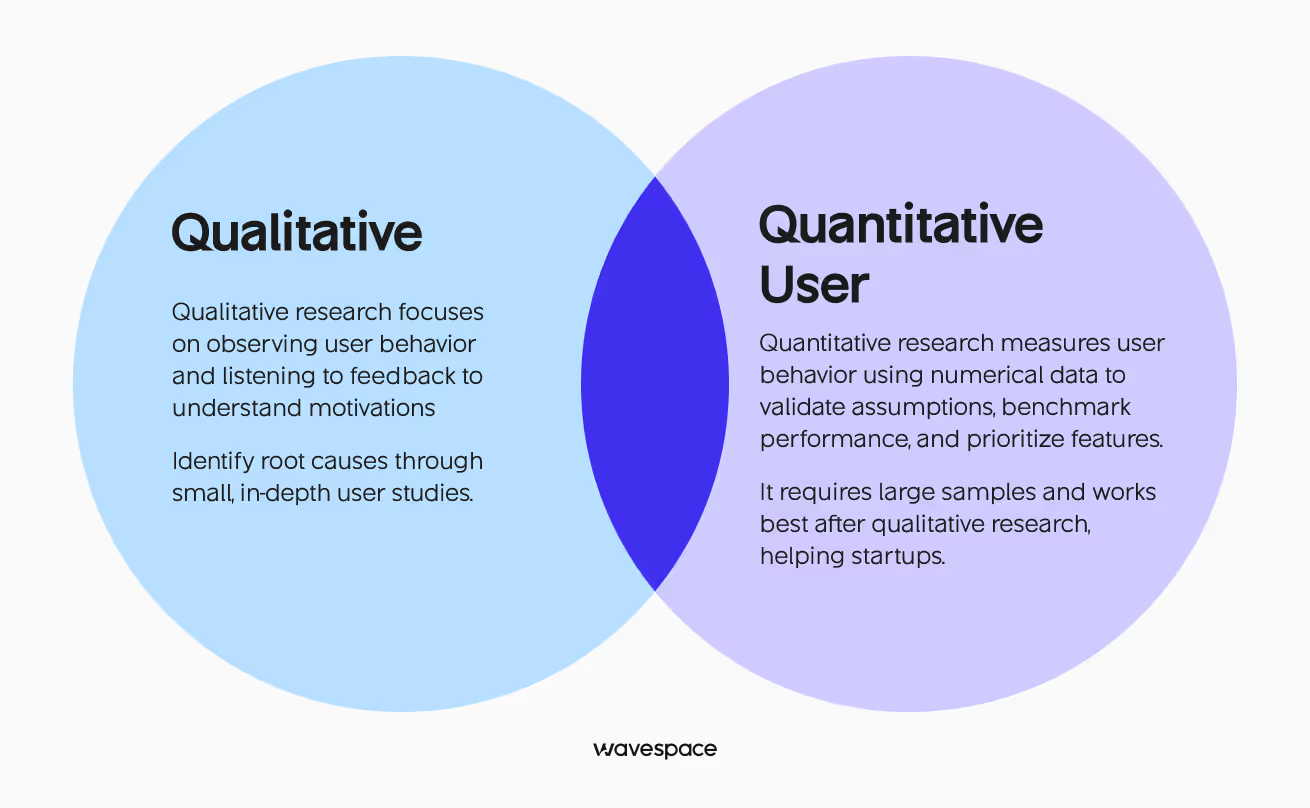
For startups, understanding which type of data to collect is as important as collecting it.
Qualitative research: How and Why
Qualitative research of UX research focuses on observing users. Meaning, their behavior and listening to feedback to understand the user’s motivation.
- Best for: Exploring new ideas. Finding the unknowns. Simply put, understanding the root cause of a problem.
- Sample size: Small (5-8 users are enough to diagnose 80% of usability issues).
- Methods: Interviews, diary studies, and session replays.
Quantitative research: How many and How much
Quantitative research uses understandable numeric data to measure behavior and validate IFs.
- Best for: Benchmarking performance. A/B testing. And prioritizing features based on usage frequency.
- Sample size: Large (Typically, a bigger team is needed to achieve statistical validation).
- Methods: User surveys, analytics review, A/B testing, and clickstream analysis.
- Startup strategy: Startups should begin with Qualitative research to validate product-market fit and understand user needs. Afterwards, shift to Quantitative research to optimize heavy traffic.
UX research methods
Continuous discovery
Popularized by Teresa Torres, Continuous Discovery is an agile process that a team carries out to conduct customer research. It involves weekly customer touchpoints. Across the entire development phase.
The goal of continuous discovery is to shift research from a project to a team habit. It also ensures the product team validates guesses against customer reality.
Lean startup methods
For early-stage startups, it is not pocket-friendly to build and deliver a full product to test user demands. Startups need to build something that a general user wants. For that, they need to uncover user's interests.
- Wizard of Oz Prototype: The team fakes a fully functional feature outside. However, it works manually behind the scenes.
For example, an advanced chatbot that is actually a human giving the responses manually. This way, a startup can work out the value of a feature before coding.
- Fake Door Experiment: This is a powerful quantitative validation tool to determine how many users are willing to try a feature.
Creating a core page or a button (Try AI Study Planner) for a feature that doesn't exist. When a user clicks to use the feature, they see Coming Soon " or " Join the Waitlist.
It is an excellent way for startups to measure user interest (click-through rate) before building it.
Usability testing
- Moderated: A researcher guides the user. Instruct them to find the reason which part or why users are confused.
- Unmoderated: Let the users complete tasks alone. This is faster and cheaper, but it can lack the depth of data gathering.

Methodological spectrum: Generative vs. Evaluative
A complete research strategy is not binary; it contains the duality of both sides.
It's critical to know the difference between Generative and Evaluative research. Most important for companies looking to grow their product. It helps them choose the perfect agency and its services.
Generative research (Problem discovery)
Discovery occurs before a solution exists. It belongs to Problem Space. Mainly analyzes existing problems and defines what to build to solve those. It concentrates on understanding how a user wants to solve a problem. From their angle, environment, latent motives, mental models, and workarounds for pain points.
Methodologies:
- Ethnographic field studies: Observing users in their natural environment (Logistics manager using a spreadsheet ).
- Diary studies: Asking users to log their interactions and patterns. Feelings over time to solve.
- Contextual inquiry: A semi-structured interview method where the researcher observes user work and has a questionnaire session.
Startup application: Non-negotiable for Pre-seed and Seed-stage startups. Without Generative research, many build something (a solution in search of a problem) that has no use in the market.
Deliverables: User personas, Empathy maps, Mental models, and Experience maps.
Evaluative research (Solution testing)
Evaluative research occurs once a concept or product exists in the market. It belongs to the Solution space. The target is to discover how well the proposed solution solves the problem. It is about refinement, optimization, and increasing usability.
Methodologies:
- Usability testing (moderated): A researcher guides the user to use the product and learn why.
- Usability testing (unmoderated): Collects user’s task completion records and gathers pass/fail data.
- Tree testing: Checks information architecture (navigation structure) before designing the UI.
- A/B testing: Compares two live versions of a design. And select which performs better statistically.
Startup Application: Critical for Series A and Growth-stage companies focusing on Conversion Rate Optimization (CRO), retention, and reducing churn.
Deliverables: Usability Reports, Heatmaps, System Usability Scale (SUS) Scores, and Pass/Fail Metrics.
Final thoughts
Getting a UX research agency is not only about outsourcing the research. It means choosing a partner to clarify your product. The right agency helps you avoid making wrong decisions, reveal secrets of user motivations, and translate insights into actual business effects.
This list shows the metrics of choosing a UX research agency for growth. Generative, lean research partners can be perfect during the early stages to define the problem space, whereas evaluative research is required by growth-stage companies to maximize usability, retention, and conversion.
The important factor here is to align the vision of your company. Its goals and limitations, with an agency’s strengths and methodology.
Choose wisely; Be an early investor. Good UX research pays off x1000, in terms of increased trust, adoption, and improved product-market fit.
Frequently asked questions about UX research agencies

UX research is a systematic process of finding out what a user needs, where they feel confused, and why. This process includes watching people use the product and running user interviews to figure out their pain points. The goal of UX is to make the product simple and make users stop guessing and start making decisions.
No. UX research is not code or program-based work. UX research is about asking questions and finding patterns where a product struggles. UX researchers report their insights to developers to help build a better product.
Not really. As of now, AI cannot replace UX researchers. Instead, AI can help to speed up the process. It can also help to tag themes and sort survey data in a more efficient way. AI cannot spot frustrated users and fully understand human emotions. Reading the room, knowing what matters is still a human skill.
80% of users only use 20% of a product's features. The 80/20 rule emphasizes prioritizing core features. Think of a camera app; most users open the camera to take pictures. Very few use filters and other options. The 80/20 principle advises designers to build products around their core features and cut down excessive options to save resources.
It's a design guideline for color. It is a golden UI UX rule to design balanced, aesthetically pleasing products. 60% goes to the primary color for the interface. 30% goes to the secondary color that works as supporting structure. And an accent color for the remaining 10%. 60-30-10 rule helps design stop being chaotic and gives it a more professional look.

More related blog
Design & development in one team. Let’s talk!















.png)



Francisco, CA 94105, United States





































.avif)