Product design process: from idea to launch (10 steps)




And now we will get to the point most people would like to know.
The UX design process is an organized method of knowing the user, problem definition, solution design, and idea testing and launching of products that are easily usable and simple to the users in real life.
I’ve seen teams skip steps and pay for it later. Features looked good on screens, but users struggled in real life. The reason why this guide is different is that it is a reflection of the UX design process in real product teams being used, rather than being described in theory.
And this guide is written for designers, founders, product managers, and teams who want clarity. When you are attempting to create something that people can trust, use, and revisit, the UX design process is not an option. It is the foundation.
What is UX design?
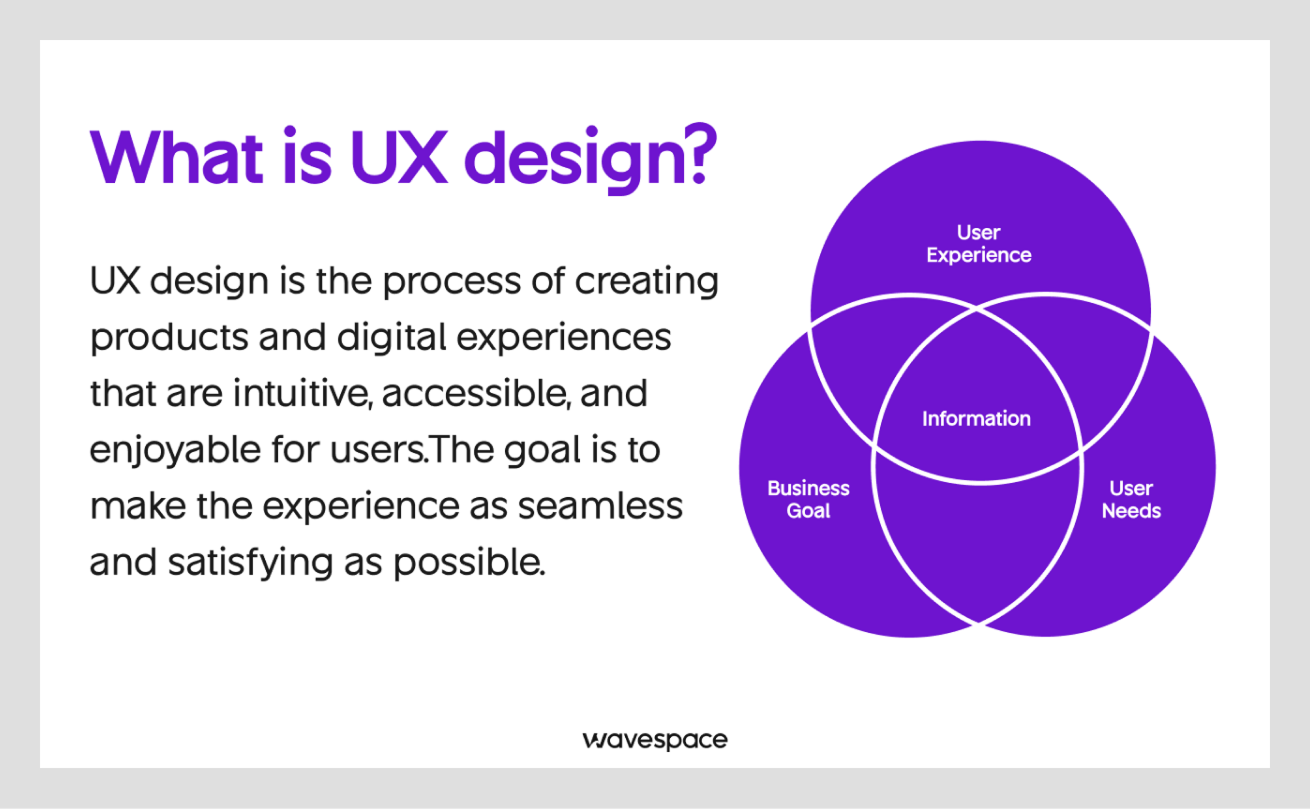
The concept of UX design is designing digital experiences that are straightforward, helpful, and user-friendly. It concerns the way users think, feel, and behave when they go through a product. The UX design has a simple objective. Make the users get what they were seeking without getting lost or frustrated.
That includes usability, accessibility, clarity, and efficiency. It is not limited to screens or visuals. It involves structure, flow, and decision-making at each stage.
In actual products UX design appears in results, but not in decoration. In a product dashboard redesign that I worked in, the interface was okay, yet the users continued to suffer. Once the task flow and steps were optimized, users took less time to accomplish actions without even introducing new features. The number of support requests decreased as the experience became comprehensible.
And UX design is not about making assumptions about what people want. It concerns listening, testing and adjusting. Since when UX design is properly completed, users are not aware of the design. They simply have confidence in the product.

What is a UX design process?
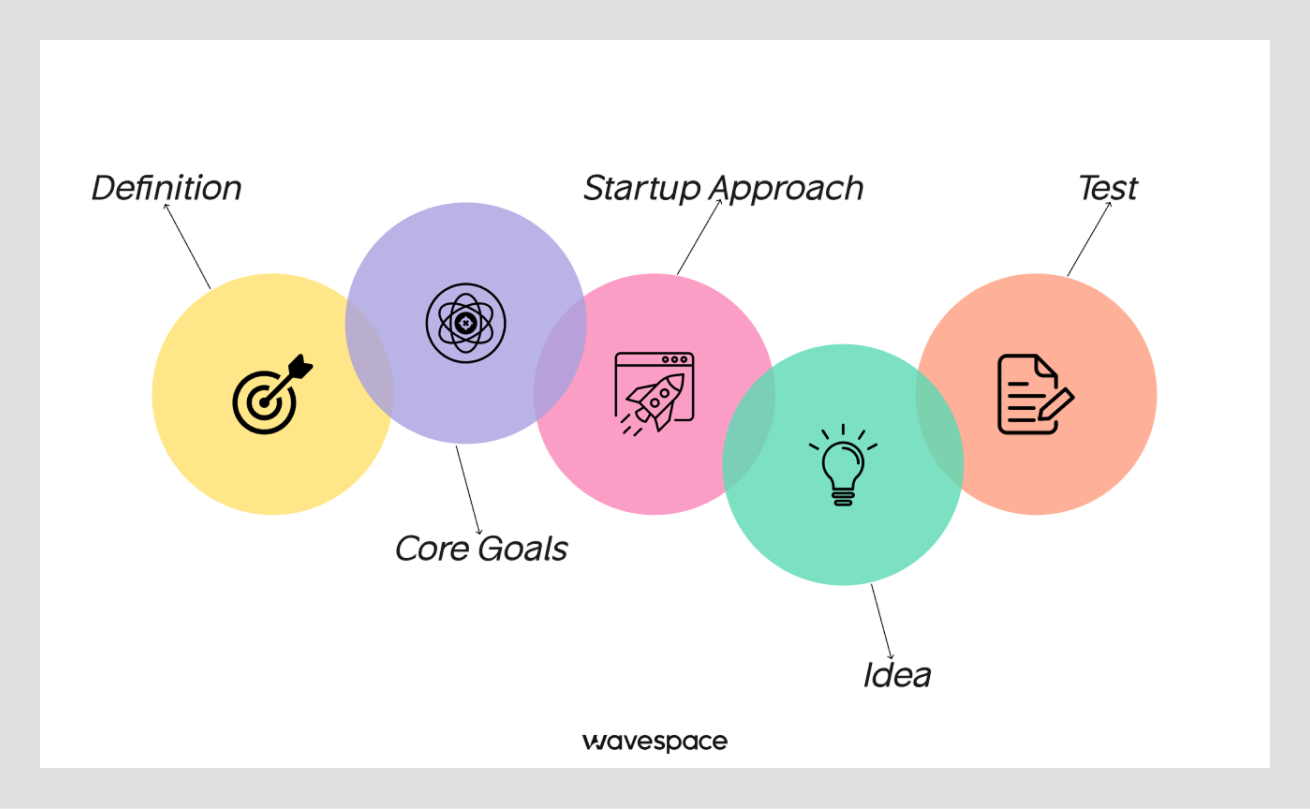
The UX design process is a step by step method of designing the product based on the actual user requirements. It enables teams to know users, state problems precisely, find solutions, and test ideas (before creating them). The UX design process is not based on guesses but rather through research and validation.
Depending on their stage and objectives, different teams have different UX design methods. A lighter process is commonly applied in early-stage startups. They are concerned with fast research, faster testing, and faster learning. Enterprise teams tend to have a more rigid UX design process with more research, documentation and approvals.
The process of the UX design also varies according to the type of the product. SaaS products are concerned with task efficiency and clarity since users need to accomplish work in a short time. Consumer apps are more emotional, more engaging and build the habit. It is a process that is responsive to these requirements.
And the UX design process is not a linear one. There is a tendency of back and forth movement between steps by the teams. Good UX design is the process of learning, refining and making decisions that are more effective with each product development.
Why is the UX design process important?
The importance of the UX design process is that it enables the teams to make superior decisions before the expensive development process starts. It minimizes the level of guesswork, streamlines teams, and ensures that the focus remains on actual user requirements rather than assumptions. When it is not done properly or in a hurry, products end up appearing good but failing in day-to-day use. The following are the real reasons why the UX design process is so important.
User-centric solutions
The process of UX design maintains the users at the center of all decisions. In one of my redesigns of onboarding to a SaaS, users were expected to know the language of the product. Research proved otherwise. The redesign of flows based on the way users think actually led to the enhancement of task completion without introducing new features. Teams that do not do this typically go out of their way to build for themselves, and not for users.
Quality and consistency
A clear UX design process creates consistency across screens, features, and interactions. Inconsistent patterns are currently among the most typical types of problems in usability audits. With teams using a process, design choices are recorded and recreated virtually. This will have reduced errors and a more predictable user experience.
Collaboration and communication
The UX design process gives teams a shared language. Designers, developers, and product managers can align around user goals instead of personal opinions. In cross-functional teams, this process reduces friction because decisions are backed by research and testing, not hierarchy or guesswork.
Economic efficiency
After development, it is costly to fix usability problems. The UX design process helps teams to identify problems in early stages. I have personally witnessed products months and months away before fixing the features that would have been confirmed in a few days after initial testing. Spending time on UX now saves time in development in the future.
Brand loyalty and trust
People believe in things that are user-friendly and dependable. An intelligent UX design process will produce experiences that are deliberate. Users do not struggle and stay longer, and visit regularly. Being a quiet builder of trust and not a noisy marketer.
Increased conversion rate
Ease of movement and fewer frictions have a direct impact on conversions. Small UX improvements in a checkout/signup flow can result in significant improvements. When teams use the UX design process, they know where users are getting stuck and why, and create a design that eliminates that friction.
SEO and visibility
Good UX facilitates SEO, enhancing engagement, readability, and completing tasks. Search engines prefer useful experiences for the users. It sends positive signals when users spend more time and interact smoothly. The combination of UX and SEO is more effective.
Inclusive and accessible experiences
The UX design process assists teams to design in various abilities and contexts. Without a formal procedure, accessibility is usually disregarded. The earlier a product is considered, the more people can use it without having to rework it heavily. Inclusion teams create better products that are ethical.
Since the UX design process is not a design polish. It is regarding how to safeguard users, teams, and businesses against unnecessary failure.

What’s the difference between the UX design process and the design thinking process?
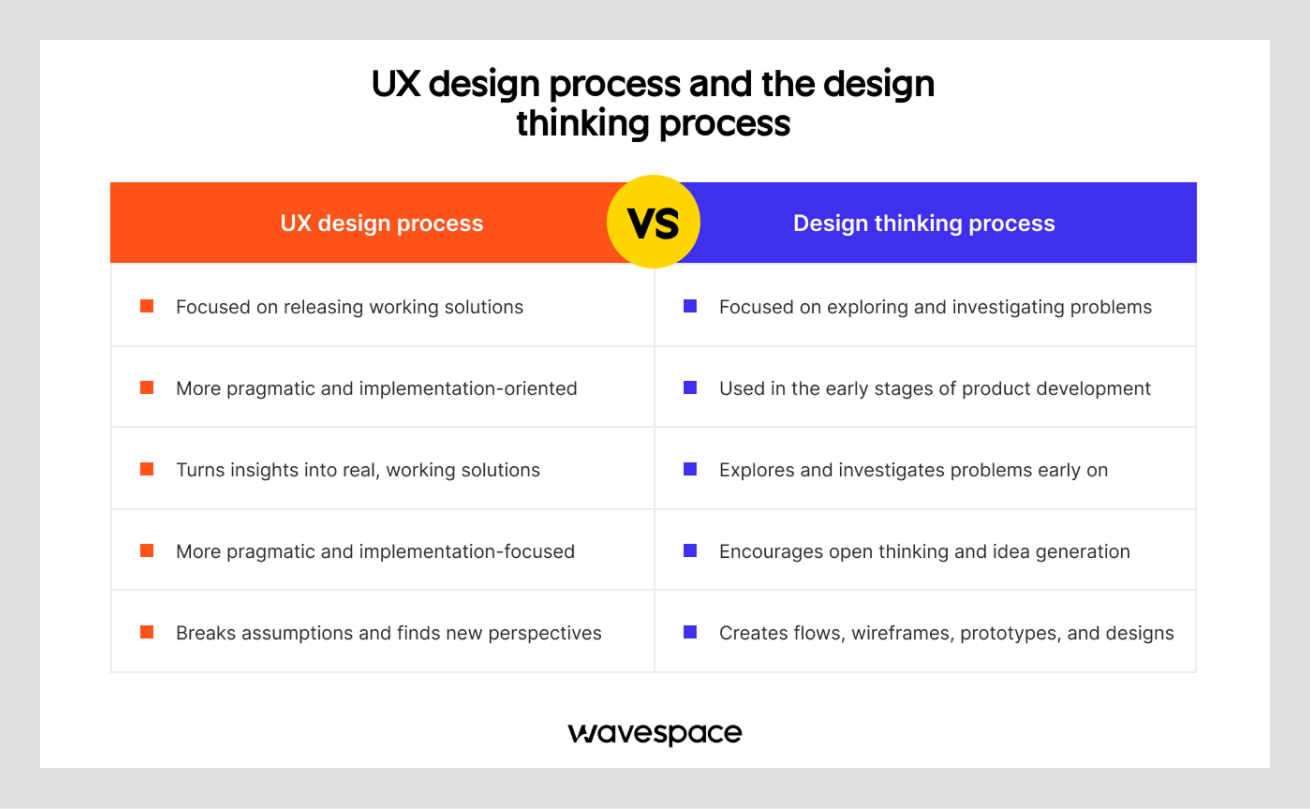
The main difference is simple. The design thinking helps groups in investigating issues. The process of UX design helps the teams in releasing working solutions. They are both useful, but at various stages of product development, they are used differently.
The concept of design thinking is applied at an early age. It promotes general thinking, understanding, and the generation of ideas. Teams investigate user needs, break assumptions, and analyze problems from new perspectives. This is effective when a problem is not clear or when a team is in need of direction. Design thinking alone is not enough structure to create and introduce a real product.
The process of UX design is more pragmatic and implementation-oriented. It turns insights into flows, wireframes, prototypes, and tested designs. The UX design process in real product teams will answer questions such as how users will accomplish tasks, where they will encounter difficulties, and what they will need to do before launch.
In practice, I have found design thinking most effective when design thinking is at the start of a project. However, when there is direction, teams require a UX design process to proceed. Teams that remain in design thinking excessively find it difficult to decide. Those teams that do not consider the UX process fail to deliver consumable products.
According to design thinking, you figure out what to create. The UX design process helps you create it correctly.
Types of UX design process
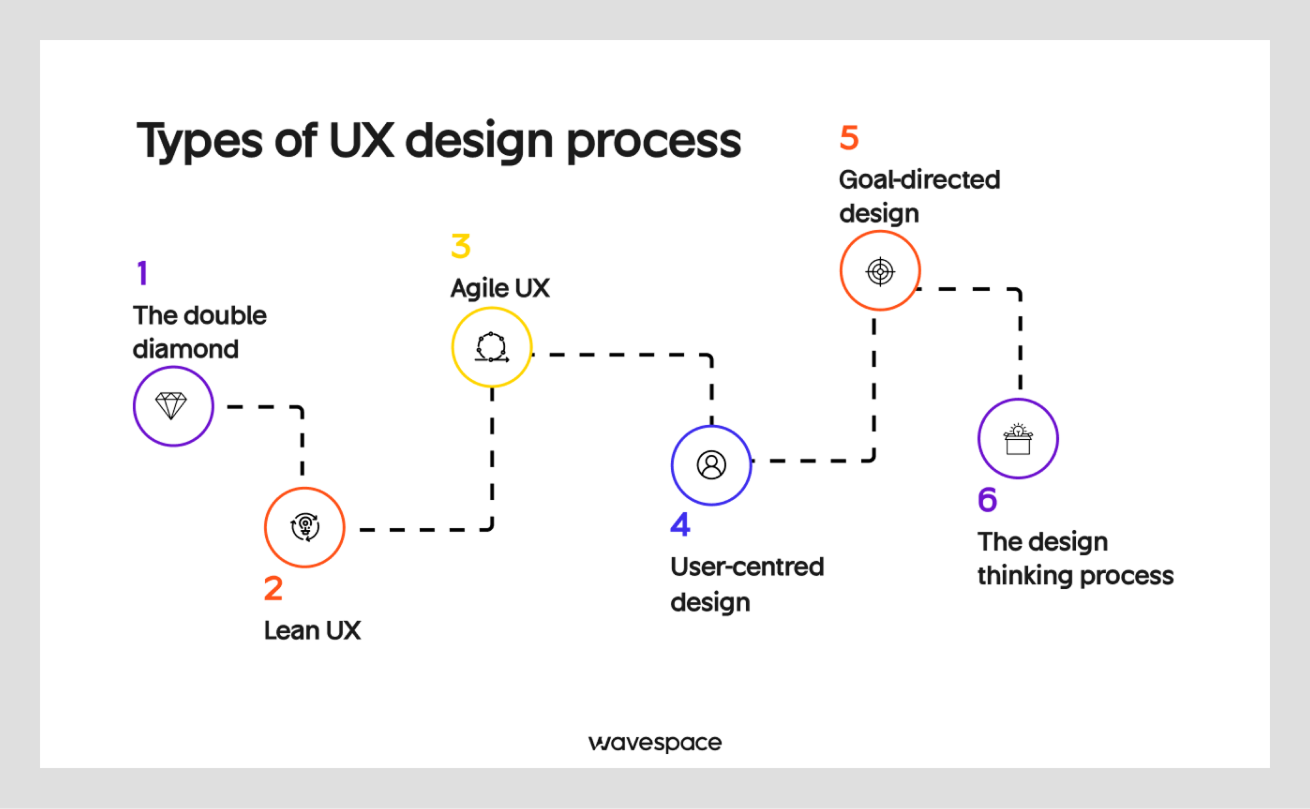
No single UX design process fits all the products. The various processes selected by teams are dependent on the maturity of the product, risk, time, and business objectives. Models of the UX design process have changed over time. All of them address a different kind of problem and have obvious trade-offs.
Understanding these types helps teams choose the right approach instead of blindly following trends.
The design thinking process
Best for: Exploring problems when direction is unclear
Limitations: Not enough structure to deliver final products
The design thinking methodology is based on empathy, ideation, and experimentation. It enables teams to get a profound insight into users and challenge assumptions. It is a valuable process when starting a project, particularly when teams are not yet aware of what problem to solve.
Design thinking is relevant in real projects because teams do not create the wrong thing. However, teams can find it difficult to continue depending on it. I have experienced a situation where teams made terrific ideas and could not deliver due to the lack of an execution plan. Design thinking is best used in combination with a systematic UX design process in the future.
The double diamond
Best for: Research-heavy projects that need clarity
Limitations: Can slow down fast-paced teams
The UX design process of the double diamond focuses on four phases of work. Discover, define, develop, and deliver. Teams broadly find out problems and then narrow down to solutions. The model introduces sanity and clarity, particularly in complicated projects.
The double diamond assists in aligning stakeholders in an enterprise. However, when you are a startup or in a high-paced team, it may be inflexible. Informally, teams can bypass steps to ensure speed.
User-centred design
Best for: Products serving diverse or sensitive user groups
Limitations: Requires ongoing access to users
User-centred design considers the user in all decisions. Testing and research are not only in the beginning. The result of this approach is high usability and accessibility.
User-centred design avoids expensive errors in healthcare and finance products. However, it requires time, research, and access by a user. Without such resources, teams find it difficult to use them effectively.
Lean UX
Best for: Early-stage startups and MVP development
Limitations: Easy to misuse without research discipline
Lean UX focuses on speed, learning, and iteration. Small, test, and adapt based on feedback are all characteristics of teams. This strategy helps teams to learn quickly in uncertainty.
However, lean UX frequently fails when teams mistake speed for omitting research. I have observed products that travel very rapidly and that fail to satisfy users. Lean UX is most effective when the teams do not ignore user validation, although it can be lightweight.
Agile UX
Best for: Teams working alongside agile development
Limitations: UX can become reactive
Agile UX incorporates design in brief development cycles. Designers work hand in hand with developers, removing handoff problems. This enhances performance and speed of delivery.
But unless UX work is planned out, it may be done in a hurry. They could result in designers responding to sprint needs rather than creating the product experience. Agile UX demands that designers be one step further.
Goal-directed design
Best for: Task-focused products with clear user goals
Limitations: Less flexible when goals change
Goal-directed design revolves around the aims of the users. Decisions are made using personas and scenarios. This assists teams in preventing feature overload and staying result-oriented.
This strategy brings transparency to productivity tools and SaaS platforms. But when user goals shift or evolve, teams must revisit assumptions to stay relevant.
There is no ideal UX design process. Good teams do not follow trends and templates, but rather select, adapt, and integrate processes depending on the real limitations and user requirements.
What are the 10 steps of the UX design process?
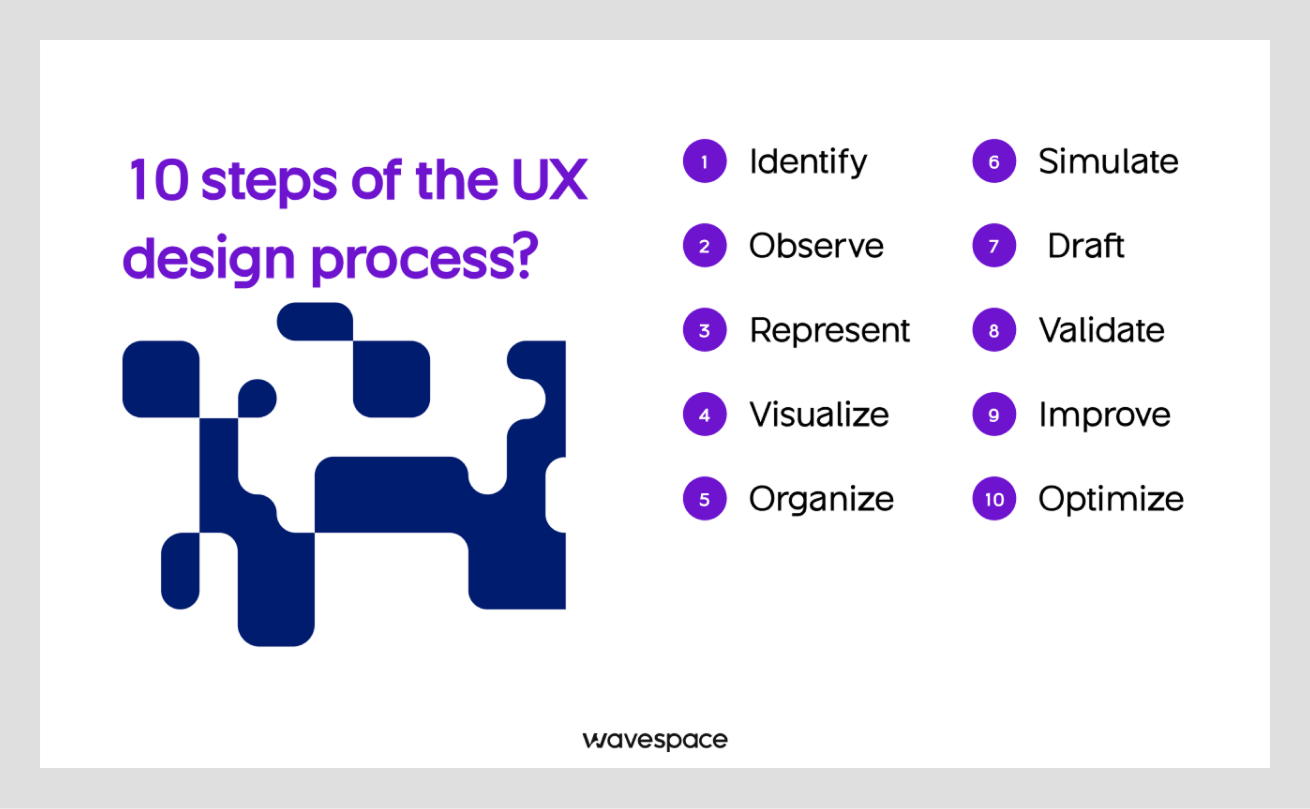
The process of UX design is a learning system. Every step has its purpose to provide the answer to a particular question before teams spend more time, money, and effort. When these steps are done in the right way, the teams reduce the risk early and develop products with confidence rather than hope.
The 10 steps have been explained in detail in the following in an educational manner based on actual product work.

Step 1: Find the alignment of the stakeholders
What this step is really about
This step exists to answer one uncomfortable but critical question early: What are we actually trying to achieve, and why?
The teams must have a common understanding of goals, constraints, timelines, risks, and decision ownership before any research or design work commences.
What actually happens in real teams
There is an agreement between the stakeholders on business goals, user effects, technical constraints, and trade-offs. It brings out assumptions and documents them. This forms a common reality rather than silent expectations.
Common real-world mistake
Teams rush through this step because it feels like talking instead of doing. Alignment stays verbal, not documented. Later, when designs are reviewed, everyone remembers the goal differently.
Real outputs
Clear problem scope, success definition, known risks, assumptions list, and stakeholder priorities.
Bottom line
When this step is skipped, teams do not lose time. They lose direction. And without direction, even good design work ends up being questioned, changed, or rebuilt.
Step 2: User research and planning
What this step is really about
This step answers a simple but powerful question: Who are we designing for, and what do they struggle with today?
The process of UX design relies on evidence. Research turns opinions into insight.
What actually happens in real teams
The teams monitor the users, interrogate them, study behaviors, and find patterns. Studies are not required to be bulky. Even small efforts will bring blind spots to teams that were not aware of them.
Common real-world mistake
Teams are based on internal assumptions or just listen to confident users. They ignore quiet and confused users or even new users, yet these struggle the most.
Real outputs
Feedback, pain points, behavioral patterns, language that users use, and research summaries that inform decisions.
Bottom line
When this step is skipped, teams design for themselves. And internal logic products often do not make sense to actual users.
Step 3: Define the problem and success metrics
What this step is really about
This step exists to answer: What exact problem are we solving, and how will we know we solved it?
Without this clarity, design is subjective and difficult to judge.
What actually happens in real teams
The insights of research are transformed into problem statements and experience goals that are measurable. These serve as a checklist for all subsequent design decisions.
Common real-world mistake
Teams define vague goals like “make it better” or “improve UX.” These sound good, but give no direction.
Real outputs
User behavior success measures, experience objectives, and problem statements.
Bottom line
When issues are not clearly outlined, teams end up wasting energy refining solutions that, in a real sense, never resolve anything.
Step 4: User personas
What this step is really about
This step answers a quiet but critical question: Who are we prioritizing when we make design decisions?
User personas transform the whole research into a living, thinking of actual individuals, their objectives, constraints, and inspirations.
What actually happens in real teams
Teams synthesize research findings into a small set of representative user types. These personas are based on actions, requirements, and decision-making trends and not degrees. They serve as guidelines in designing.
Common real-world mistake
Teams make assumptions about personas or make them too generic. Instead of being the tools of the decision process, personas become posters on a wall.
Real outputs
Primary and secondary personas based on research, such as goals and pain points, and the context of use.
Bottom line
Weak personas may cause teams to design for everyone and succeed in serving no one specifically.
Step 5: Journey mapping and task flow
What this step is really about
This step answers: How does the user move from intent to outcome, and where does friction appear?
Journey mapping is a perspective that is not focused on the screen, but on the experience.
What actually happens in real teams
Teams visualize the user actions, thoughts, emotions, and choices between major scenarios. Task flows explain the process of users updating their goals step by step.
Common real-world mistake
Creating screens without being aware of how users get to that point or what they do once they get there.
Real outputs
User journey maps, task flows, friction points, and opportunity areas.
Bottom line
Ignoring journeys makes teams solve local problems, but the overall experience remains shattered.
Step 6: Information architecture and content structure
What this step is really about
This step answers: Can users find what they need without stopping to think?
Information architecture determines the structure of content and features, and labels.
What actually happens in real teams
Teams group content based on user mental models, test navigation logic, and refine labels to reduce cognitive load.
Common real-world mistake
Structuring content based on internal teams or technical systems instead of how users think.
Real outputs
Site maps, navigation structures, content hierarchies, and naming conventions.
Bottom line
Even designed interfaces become confusing and slow to use when the structure is not clear.
Step 7: Wireframing and interaction design
What this step is really about
This step answers: How does the experience work before visual styling is added?
Wireframes bring out the concentration on layout, flow, and interaction logic.
What actually happens in real teams
Teams sketch and test low-fidelity layouts to validate usability early. There is a clear definition of interactions like states, feedback, and transitions.
Common real-world mistake
Jumping to high fidelity UI too early and debating visuals instead of usability.
Real outputs
Low to mid fidelity wireframes, interaction rules, and flow diagrams.
Bottom line
When wireframing is skipped, usability problems hide behind polished visuals and surface too late.
Step 8: Prototyping and validation
What this step is really about
This step answers: Does this solution actually work for real users?
Prototypes enable the teams to test ideas without creating them.
What actually happens in real teams
Designs are presented in the form of clickable prototypes and tested on users. Feedback shows confusion and unmet expectations as well as hesitation.
Common real-world mistake
Teams test in-house and expect users to act in the same manner.
Real outputs
Interactive prototypes, usability discoveries, and iteration insights.
Bottom line
Skipping validation means that teams operate without knowing it.
Step 9: Design system alignment
What this step is really about
This step answers: Can this design scale consistently over time?
Design system alignment provides consistency, efficiency, and reuse.
What actually happens in real teams
Designs are also matched with the current components or modified to extend the system responsibly. Trends are recycled rather than rediscovered.
Common real-world mistake
Building bespoke solutions to the short-term issues, but with long-term design debt.
Real outputs
Components and design tokens that can be reused, and usage guidelines.
Bottom line
Ignoring systems makes teams slower in the long term and lacking in visual and interaction consistency.
Step 10: Usability testing, iteration, and developer handoff
What this step is really about
This step answers: Can this be built correctly and improved after launch?
The work of UX does not conclude with the completion of design files.
What actually happens in real teams
The Final designs are tested, refined, documented, and explained to the developers. Designers stay involved during build and QA.
Common real-world mistake
Making handoff a point of responsibility rather than a point of collaboration.
Real outputs
Final usability findings, refined designs, specifications, handoff documentation, and QA notes.
Bottom line
Even UX design can become a poor user experience during production when handoff is poor.
What are additional practical ways to implement UX design in real teams?
Knowing the UX design process is not the last step. The actual trick is to implement it in cases where teams are pressed in terms of deadlines, growth objectives, and technical boundaries. These limitations also apply in large businesses. An example of this is a famous example of Airbnb, in which UX design became a decision-making tool instead of a visual step.
Airbnb UX case study
At the initial stages of development of Airbnb, the team observed a definite trend. Users were searching for locations but not making reservations. The data revealed drop-offs, and the numbers could not tell the reason. Airbnb used the UX design process appropriately; instead of redesigning screens at once, it began with user research.
Airbnb found out that the interface was not confusing to the user through the use of interviews, usability testing, and behavioral analysis. They did not know how to trust. People also had questions about whether something was real, about whether the hosts were trustworthy, and what would happen in case something went wrong. This insight changed the way UX was applied between teams.
Instead of introducing additional functionality or promotional messages, Airbnb worked on minimising uncertainty at the precise points when consumers required some reassurance. UX designers worked closely with product and engineering teams to map the booking journey and identify emotional friction points. The reviews, host profiles, verified photos, and transparent policies were not hidden by additional clicks.
This example brings up an important point of UX application. The UX design is most successful when it determines what information is displayed, where it is displayed, and when it is displayed. Not when it is considered as visual polish once the decisions are already made.
The UX was also a constant learning process in the teams at Airbnb. Designs were tried, improved, and tested. In case this change failed to decrease hesitation or raise confidence, it was reconsidered. The implementation of UX was not final.
Collaboration is another important lesson of Airbnb. The UX design did not exist in the design team alone. Engineers guaranteed quality and efficiency. The UX decisions were aligned with business goals by product managers. Leadership was an investment in UX in the long term. This shared ownership allowed UX improvements to scale across the product.
This UX strategy is not a hypothesis. The UX practices and design of Airbnb have been extensively explored and reviewed by reputable members of the UX society, such as.
• Airbnb design team publications and talks
The size of Airbnb is not what makes this example practical. It is the mindset. Airbnb applied UX design, which made better decisions in the face of real constraints, rather than step-by-step.
This is the true lesson of most teams. The UX design is effective when it minimizes uncertainty, sets priorities, and defends the trust of users. In this manner, UX is no longer an additional task. It is the decision of real teams on what is worthy of building.
Questions about the UX design process

The UX design process is a structured way to understand users, define problems, design solutions, test ideas, and improve experiences before and after launch. It helps teams move from assumptions to evidence, so products are built based on real user needs rather than guesswork.
The key stages usually include discovery, user research, problem definition, design, validation, and iteration. While the order may vary, each stage exists to reduce risk, improve clarity, and ensure decisions are grounded in user behavior, not internal opinions.
The UX design process typically involves stakeholder alignment, user research, defining problems, creating personas, mapping journeys, structuring information, wireframing, prototyping, testing, and iteration. These steps guide teams from understanding users to delivering usable, scalable solutions.
A strong UX design process is user-centered, evidence-based, iterative, and collaborative. It prioritizes clarity over assumptions, validates decisions early, and adapts to constraints while keeping user needs at the core of every design choice.
Common UX tools include Figma for design and prototyping, FigJam or Miro for collaboration, usability testing tools for validation, and analytics platforms to measure behavior. Tools support the process, but decisions matter more than software.
UX design focuses on how a product works and feels, including flows, structure, and usability. UI design focuses on visual presentation, such as colors, typography, and layout. UX defines the experience, while UI expresses it visually.
Design thinking helps teams explore and understand problems, especially early on. The UX design process focuses on execution, usability, and delivery. Design thinking helps decide what to build, while UX design ensures it works well for users.
The UX design process can take anywhere from a few weeks to several months. Timing depends on product complexity, research depth, and team maturity. Smaller projects move faster, while enterprise or high-risk products require deeper exploration.
Best practices include involving UX early, validating assumptions with users, documenting decisions, collaborating across teams, and iterating continuously. The strongest teams treat UX as a decision-making system, not a one-time design task.
Businesses should invest in UX design because it reduces risk, saves development costs, and builds user trust. Products with strong UX are easier to use, easier to scale, and more likely to retain users over time.

More related blog



Have a Project? Let’s talk!





.png)