How to choose a UX design agency for your brand in 2026


Picking the wrong UX design agency can cost you months of work and tens of thousands of dollars. I've seen it happen over and over again. A startup spends 6 months with the wrong team, ships a product nobody wants to use, and then the cycle repeats. Most of the time, the project gets canceled after taking a huge loss.
If you're reading this, you probably want to avoid that. Good. In this guide, I'll walk you through what a UX design agency actually does, why it might make sense for your brand in 2026, how to spot the right fit, and how to hire a UX design agency for your product.
What does a UX agency do?
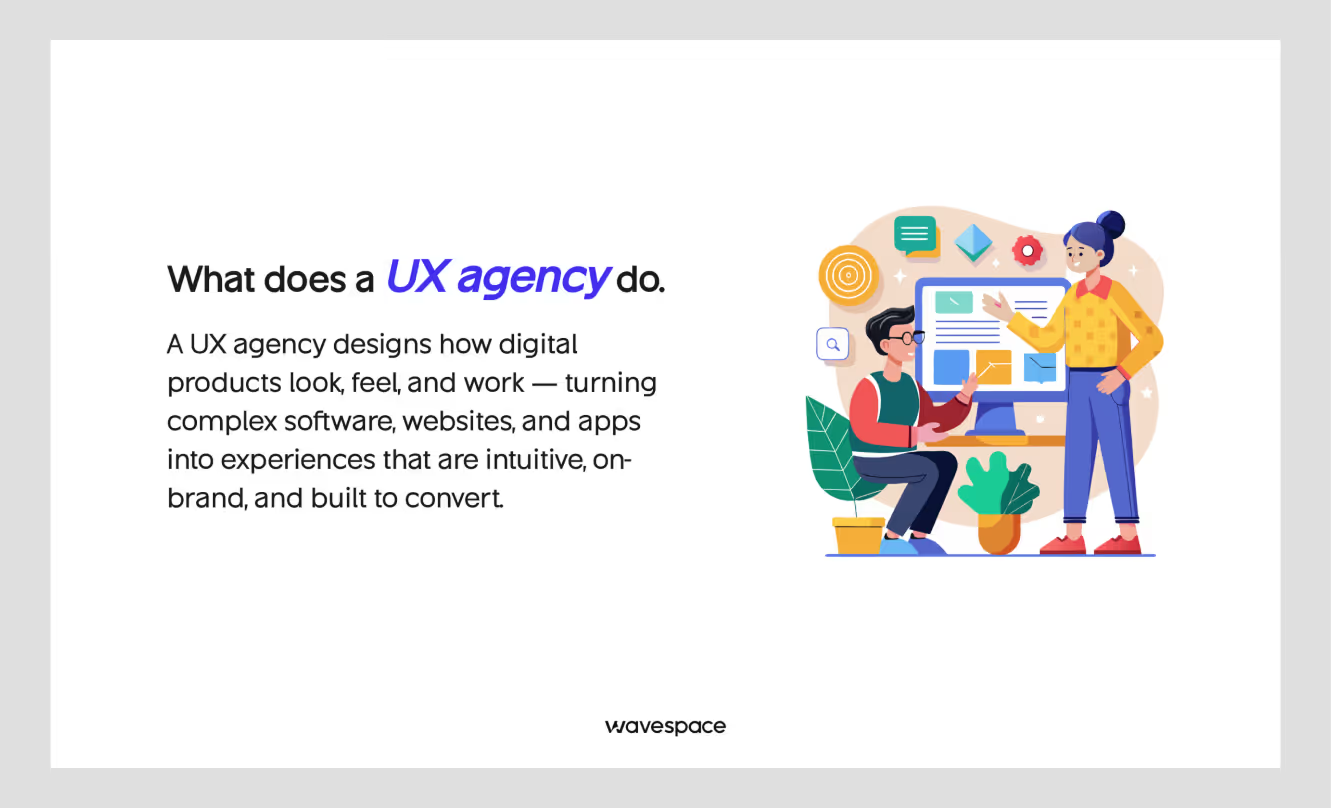
A UX design agency handles the user experience side of your digital product. They conduct UX research and tackle how a product looks, works, and solves issues users are having a hard time figuring out.
It includes a wide range of work: UX audit, user research, wireframing, prototyping, interface design, usability testing, and design systems. However, some UX agencies go deeper into the strategy of a product. Others focus mostly on execution.
The best ones do both at the same time. In 2026, many UX agencies have also started building for AI-native products, designing interfaces. Interfaces where users interact with AI assistants, data dashboards, or agentic workflows.
This type of agency is great if you're building a B2B SaaS or an innovative AI product.
Why hire a UX design agency for your brand?
Because good UX provides a satisfying experience that users appreciate. And bad UX or neglected UX is both expensive and tough to fix later. This is the reason well-planned founders think about UX early. One mistake in UX ruins the user experience and frustrates users.
From personal experience: I’ve been using a SaaS business growth product. I can tell that the founders of this product haven’t thought about the UX for this reason. I’m having second thoughts about renewing my subscription.
Run the math: if 10 paying pro users quit for a bad user experience, you are losing thousands and never getting them back. If they renew and stay for a satisfying experience, you have earned a couple of lifetime users.
Most founders and product teams know their product inside out. This is the main problem. You know how it functions, but a new user doesn’t. A UX agency closes that gap and gives an outside eye. UX agencies have seen hundreds of products; they know what works and where users might struggle.
For SaaS companies, B2B platforms, and AI products, especially, UX isn't a make-up layer. It's how users understand your product's value in the first 60 seconds.
7 Reasons to hire a design agency in 2026

While many overconfident founders still think of UX as an afterthought. And only invest in UX when things start to go south. At that point, the product or business gets damaged beyond repair. Most of the businesses fail, and revival costs more than the initial launch budget.
A popular online ticket service contacted us right after their UI overhaul. The website looked nice and modern; however, the issue occurred after the redesign. They lost 20% of their conversion rate. Their good-looking and praise-collecting UI backfired.
If you are unsure about hiring an agency or whether it is the right move, here are seven reasons to hire a design agency.
1. Full design team access
When you hire an agency, you're not getting one designer. Under just one contract, you are getting a researcher, a UX strategist, a UI designer, a prototyper, and sometimes a design technologist.
Building this team in-house from the ground up would take 6–12 months of recruiting, with a salary for everyone. With an agency, you get them day one.
2. Up-to-date design trends
Technologies move fast. In 2026, every third week, a new design trend emerges. Keeping up with these trends is crucial to staying fresh and relevant.
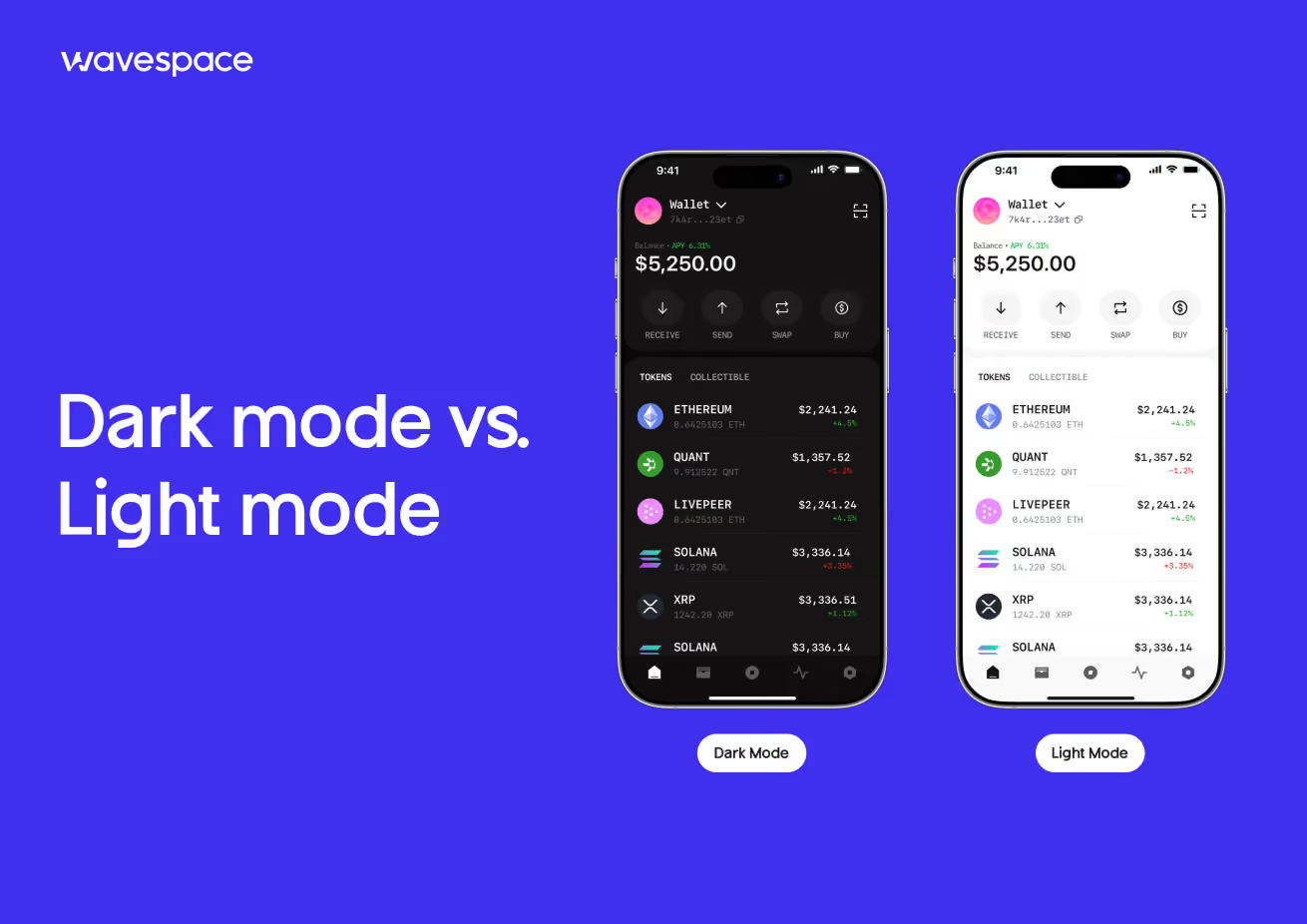
Current trends shaping product design include AI-assisted interfaces, voice UI, dark mode standards, and accessibility-first workflows.
Your in-house team has a product to ship. They barely have time to keep up with every design trend. A good agency has a dedicated person to track all of the new trends for different types of products. More importantly, their experts know which trends actually matter for your users.
3. Cheaper than in-house costs
It might surprise most people. But it's technically true. A single senior UX designer in the US costs $120,000–$160,000 per year in salary alone, before benefits, tools, and management overhead. And it doesn’t stop there for a simple product design; you’d need at least two designers and a project manager.
A quality UX agency costs around $2,000–$25,000, depending on the scope. A UX agency is a better choice when you need work done within a few months. For these situations, you don’t need recruiting costs or hiring a designer for your business.
With a design agency, there are no severance packages. No empty seat when a project pauses. For early-stage SaaS startups and B2B tech companies, the math almost always favors an agency in the first 1–3 years.
4. Easy design team scaling
Design agencies, another advance is that when you're launching a new product line, entering a new market, or running a design sprint for a big feature. You need more design output instantly, which design agencies can adjust according to your needs.
No matter the product type, SaaS, AI, or B2B design, agencies can scale up. You add that scope in the contract. They add people to the project. With it, you don’t need to post job listings, interview hundreds of candidates, or wait for someone to pass probation.
For fast-moving tech and AI companies, speed matters, and design agencies favor it the most.
5. Fresh outside perspective
I've watched product teams spend weeks arguing over a navigation structure that confuses every new user they show it to. Everyone in the brand or company knows the ins and outs of the product. This is the primary reason for minor mistakes getting overlooked.
An outside agency hasn't lived inside your product. They come in with a fresh set of eyes and ask the questions your team stopped asking two years ago. That outside perspective isn't a bug; it's the main feature.
6. Faster design delivery
Design agencies work on multiple projects all of the year. They are the experts in this field. They have processes, templates, and checklists for hundreds of brands and products.
They know what a startup needs, what a growth-stage product needs, and what an enterprise organization wants. They understand how to run a usability test and how to structure feedback rounds so they don't drag on forever.
In my experience, a focused 8-week agency engagement can outpace a 6-month in-house effort. just because the agency have their priorities set.
7. Consistent brand design
A good UX agency doesn't just design screens. They build a design system, a shared library of components, colors, typography, and interaction patterns that your product team can use forever.
Without that, every new feature looks slightly different. Every new developer makes slightly different decisions. Over time, your product feels stitched together, which can be very damaging to the brand.
Users rarely trust brands with obvious design mistakes. It can make the product feel low-quality or untrustworthy. A design system fixes that. It's one of the highest-leverage deliverables any agency can hand over.
When should you hire a UI/UX design agency?
Timing matters in the tech business. Launching a business or fixing the UX at the right time can make millions.
Here are seven situations where hiring a UI/UX design agency makes the most sense.
Pre-Seed Startups: Validating Ideas Fast
At pre-seed, you need design to validate the product. A short UX sprint turns your concept into a clickable prototype. Clickable AI or SaaS prototypes help you test product-market fit before development begins. At this stage, this gives investors something tangible to react to and make a decision.
- Turning ideas into clickable prototypes
- Building investor-ready SaaS or AI product demos
- Validating product-market fit before development
- User research for new B2B or consumer products
- Creating UX flows for MVP planning
- Testing core features with low-cost, high-fidelity prototypes
Want to learn more? Check out how UI UX design agency helps startups to launch 3X faster.
Early-Stage Startups: Building an MVP Users Love
You have funding and need to act fast to seize the market. In this stage, you can't waste six months recruiting designers. At this point, you need UX delivered in weeks. This is the sweet spot of getting full agency engagement. Hire them for UX consulting and let them handle all the UX UI design work.
- Designing MVPs for SaaS, fintech, healthtech, or AI tools
- Prioritizing core features and complete user journeys
- Creating onboarding flows to improve activation and reduce TTV
- Designing scalable UI foundations built for future growth
- Aligning UX with agile product development cycles
- Reducing development rework with better UX planning
If you’re comparing MVP development options, you may also want to read our breakdown of startup-friendly MVP development services agency.
Growth-Stage Startups: Scaling UX for Acquisition and Retention
UX is a growth opportunity after product-market fit. An onboarding flow that worked for 200 users will fail with 20,000. Great SaaS UX earns respect from the users.
- Optimizing SaaS onboarding
- Optimizing trial-to-paid conversion flows
- Improving retention for subscription
- Enhancing B2B or Fintech workflows and team collaboration
- Designing for growth-focused user experiences
- Improving UX consistency with a scalable design system
- Scaling UX for mobile, web, and enterprise dashboards
Enterprise Companies: Modernizing Digital Products
At enterprise scale, outdated interfaces cost productivity. Confusing B2B workflows can lead to high churn. In terms of enterprise design, UX design agencies are better for high-stakes modernization.
- Redesigning outdated enterprise software
- Simplifying complex B2B workflows
- Simplifying data-heavy dashboards
- Updating legacy platforms for better usability
- Creating enterprise-grade design systems
- Improving accessibility and compliance standards
Read more expert insights on enterprise design system agencies.
Major Redesign or Rebrand
It’s not a rebrand if only the logo changes while the product experience stays the same. Changing the logo for rebranding creates a jarring and inconsistent experience. A good UX agency prevents this by ensuring the product reflects the new direction.
- Overhauling an outdated SaaS or tech product
- Aligning product UX with a new brand identity
- Improving navigation and content structure
- Updating enterprise products for modern user expectations
- Rebuilding UX to support new positioning or markets
- Redesigning websites, mobile apps, or customer portals
Struggling with Conversions or User Engagement
If your business is struggling with conversions or user engagement, it’s time for a UX redesign.
A simple redesign can solve issues like high drop-off, low trial-to-paid conversion, and flat engagement. Contact a UX agency to diagnose the real cause through research to fix it.
- Fixing onboarding drop-offs in SaaS products
- Improving checkout and conversion flows in eCommerce apps
- Increasing engagement in AI apps
- Reducing churn with better usability
- Simplifying confusing product experiences
- Using UX research and testing to find friction points
Teams Without In-House UI/UX Expertise
Not every product team has a designer and hiring one takes three to six months. A UX agency gets you a specialized team immediately, without the recruiting or full-time overhead.
- Accessing specialized UX researchers and product designers
- Supporting lean startup and tech teams without dedicated designers
- Getting expert help for AI, SaaS, or B2B platforms
- Speeding up product delivery with external design support
- Improving developer handoff and product collaboration
- Filling gaps in UX strategy, research, and interface design
How to select a UX design agency for your brand
Here's what I'd look for and what I've looked for when recommending agencies to clients over the past six years.
Portfolio caliber:
Don't be impressed by a long client list. Look for 3–5 case studies in your industry (same type of product, if possible). A SaaS-focused agency will have different capabilities than one that focuses on B2B, e-commerce, or consumer apps.
UX research process:
If an agency can't explain how they validate design decisions with real users, that's a red flag. Good UX design is not grounded in assumptions. Great UX design agencies have an explanation of their decision with proof. They can articulate why and how they made a decision and what the potential outcome is.
Feedback handling:
Ask them: What happens when a client loves a design direction that the UX data doesn't support? How they answer tells you whether they're just a service vendor or a real partner.
Design system:
Ask if they'll deliver a design system at the end of the product. If they say no, ask why. A design system turns a one-time project into a long-term investment. Great design agencies will mention the design system in the discovery call and inform what will be included in the deliverables.
Communication style:
You'll be working with these people closely for months. If their first few emails are unclear, slow, or lack effort, it won’t improve even after the contract starts.
Questions to ask before final selection of design agency
Before you agree to anything, ask these questions to evaluate:
- Can I see two or three works from the previous clients?
- Have you worked in B2B SaaS <Your product category>?
- What are the most common UX issues that founders overlook in < type of project>?
- What does your onboarding process look like?
- How do you handle a situation when the design clashes with the developer?
- Who specifically will be working on my project? Will they stay on it?
- How do you measure success at the end of an engagement?
- What happens if we're not satisfied after four weeks?
- Do you deliver a design system, and if so, in which software/tool?
That last question is important. Some agencies still deliver static files that your dev team can't actually use. In 2026, your deliverables should be in Figma with proper component libraries and documentation.
Top 4 common mistakes to avoid when selecting a UX agency

These are the mistakes I see most often. People make these mistakes without realizing it's not 2013; looks and convenience don’t work anymore. There are thousands of competitors on the internet.
Most of them can be avoided with a bit of due diligence.
1. Picking for aesthetics alone
A beautiful portfolio doesn't mean the agency can provide better UX to boost your sales. Pretty interfaces that confuse users aren't good UX, they're just expensive decoration. Business doesn’t succeed on design alone. Look for business outcomes in their case studies.
2. Ignoring team continuity
Some agencies sell you on senior designers and then hand the project off to junior staff. Ask specifically who will be on your project. Get introduced to them. Slack them regularly about their progression.
3. Skipping UX discovery
Jumping straight to design without a UX research phase is one of the most common and costly mistakes I see. If an agency is eager to skip discovery to save time or budget, push back. Don’t work with them; discovery is the phase where real insights come from. Discovery can save a dying product. Without discovery, a thriving product can die.
4. Choosing the cheapest
A $1,000/month design retainer sounds great for your wallet until you realize it only covers 10 hours a month or offers amateur-level work. UX design is a skilled profession. Just like a doctor, you don’t want to get treatment from the cheapest one.
However, choosing the most expensive is also not the right call. You must choose an agency that fits your budget and your business stage. A startup doesn’t need an industry veteran to design their MVP, and an established business works with an inexperienced agency.
Remember, a good design agency will increase your revenue, and a bad agency can make you go bankrupt.
See more on 8 common UX mistakes and creating seamless user flows.
How much does a UX design agency cost in 2026?
Pricing of a UX design agency depends on agency size, experience, location, results, and scope.
Here's a rough breakdown for 2026:
Geography plays a huge part in pricing. US and UK agencies charge more than agencies in Eastern Europe, Latin America, or South Asia.
But the quality gap is close to zero, considering remote collaboration has become standard in the tech industry.
However, keep in mind that not all UX services cost the same. If your product is along the line of AI and B2B SaaS products, expect to pay at the higher end of these ranges. Reason: these products require more complex research, design, and iteration.
Design Agency vs. Freelancer vs. In-House: Which one is best?
There's no universally right answer. Some of the best businesses started with freelancers, and some had great success after working with a design agency. Kodezi is an AI product we worked with that has secured $1.8 million after our design. But the in-house design is another case.
Quick checklist for choosing the right UX design agency
Before signing a contract, run through this list:
- They have case studies in your industry (SaaS, B2B, tech, or AI)
- You've checked at least two past clients
- You know exactly who will work on your project
- They have a clear discovery and research process
- Deliverables include a Figma component library or design system
- Success metrics are defined and agreed upon before work begins
- The contract includes a revision policy and feedback process
- You've compared at least three agencies before deciding
- Their communication style feels like a good fit for your team
- Pricing is within your budget without cutting corners on research
If more than three of these are unchecked, keep looking.
Final thoughts
Choosing a UX design agency in 2026 isn't just about design; in this age, it is a business decision. The agency you choose is important. The right agency will shape how your users experience your product for years.
Take the time to evaluate properly. Don’t hold back, ask hard questions. Check case studies before hiring. And don't get impressed by a good website alone; go for a real conversation-centered design.
If you're building a SaaS product, a B2B platform, or an AI tool, good UX design is crucial. It's what separates products that users love from products that users tolerate and abandon.
The right agency will feel like a partner, not a service vendor. Investment in them, and it will pay back many times over.
FAQs

A UX design agency is a user research service provider. They conduct systematic user research on a product, find and understand users' behavioral patterns. Improve the overall experience of the users, and design it according to their research data. User research is done in a few different methods, including user interviews, usability testing, user surveys, card sorting, and analytical review.
Yes, compared to technical complexity, UX is much easier than coding. However, both of them are different and lie on opposite spectrums. UX is about understanding the user's empathy for using a product, understanding their behavior, and pain points to figure out the optimum ways to make the user’s journey easy. On the opposite side, coding is writing instructions for computers to perform specific tasks.
The cost of a UX design agency depends on multiple factors. The reputation of the design agency, designers' experiences, clients' success, location, and the product type play an important role in deciding the cost of design agencies. On average, design agencies cost 3K–100K+, depending on project size, research depth, number of screens, user testing, and agency experience. Small projects can cost 3K–10K, medium projects 10K–50K, and large enterprise or SaaS platforms 50K–100K+
To hire a UX agency, you must know what you need them for. At first, define your needs and shortlist a few design agencies, check out their case studies and relevant works for your product/project. Reach strong candidates and explain your goal, compare their proposal, and ensure the contract covers deliverables, timeline, and IP ownership.
Yes, ChatGPT can create UI design, wireframes, user flow, component ideas, and a design system. However, it’s only useful for brainstorming between ideas. Design completed by AI can have anomalies that hamper the user experience. It is advised to consult with a senior UI and UX designer before deploying for a massive enterprise.
UX and CX are different things. UX (User Experience) focuses on the overall experience of the product, how users interact with the interface and functions. CX or Customer Experience mainly covers the customer journey, including customer support, marketing, and product experience.

More related blog
Design & development in one team. Let’s talk!















.png)



Francisco, CA 94105, United States



































.avif)